working papers · 30 of them · 8 series
Papers
Each paper states its gap as a falsifiable claim with named incumbents, specifies the missing system or derives the missing law, and grades its own evidence. Every paper opens as a full reading edition in the browser — figures, math, and citations typeset on this site; the typeset PDF is the edition of record; markdown sources and harnesses live in the repository.
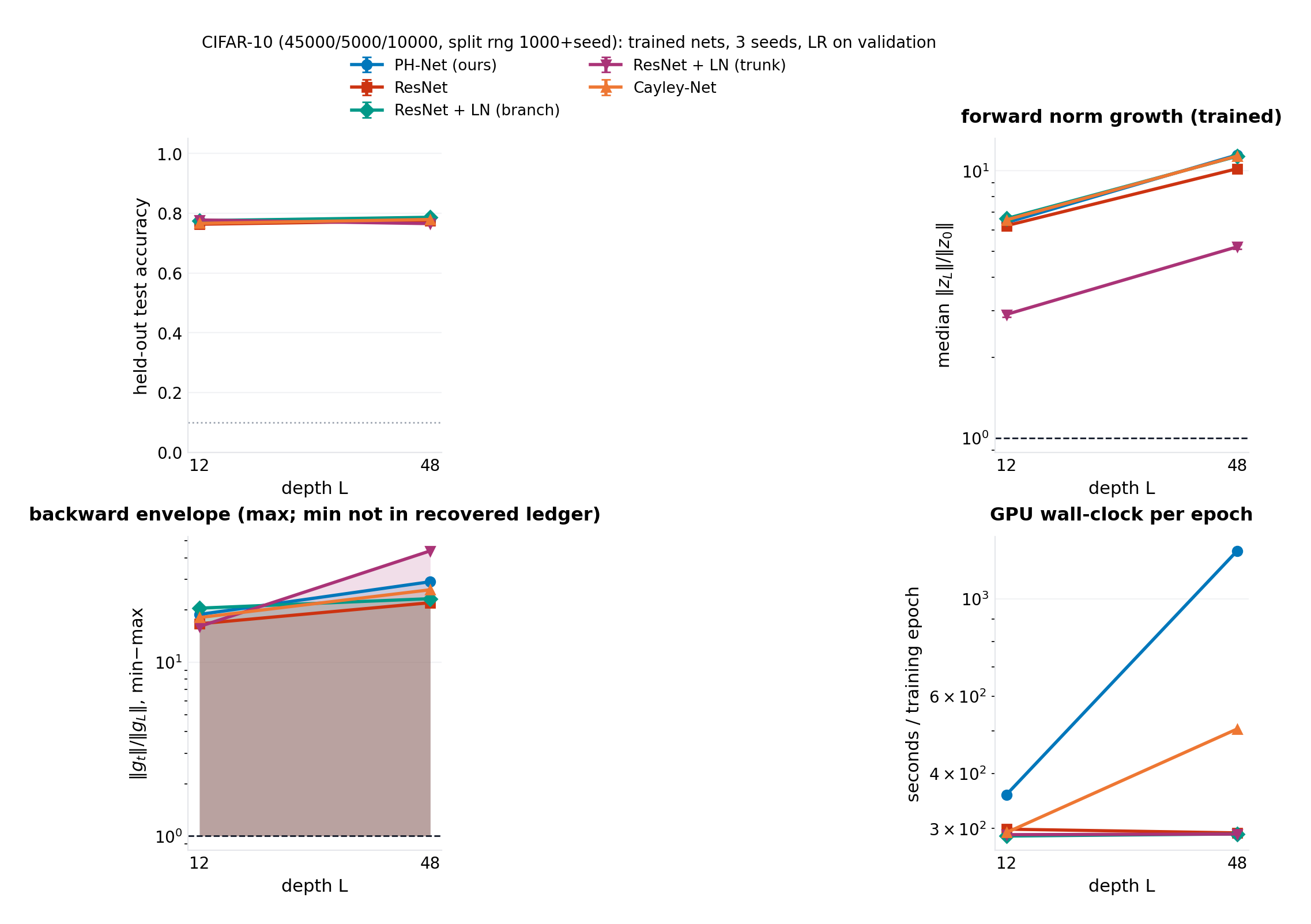 p-027 The pre-registered CIFAR-10 verdict: parity, stability, 4.4× …
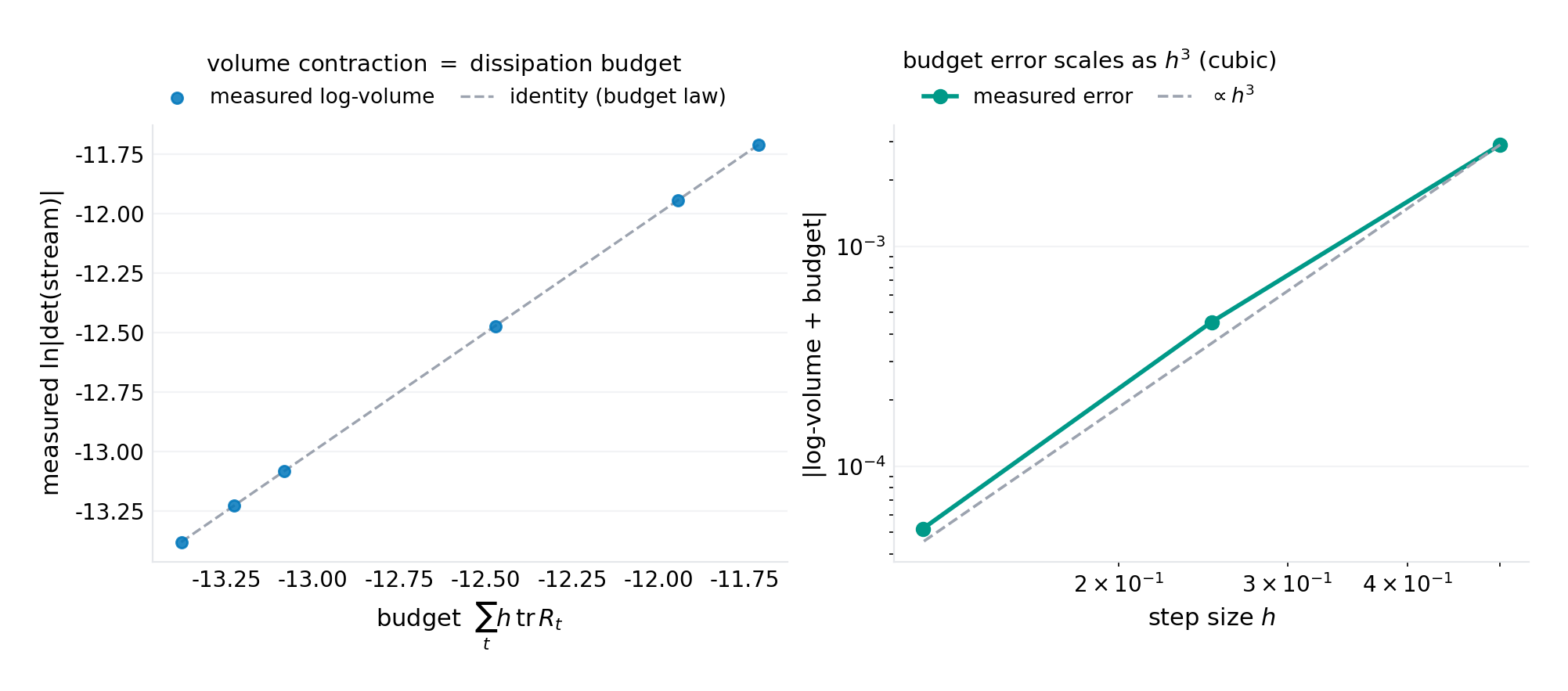 p-027 Volume contraction against the dissipation budget: the identity …
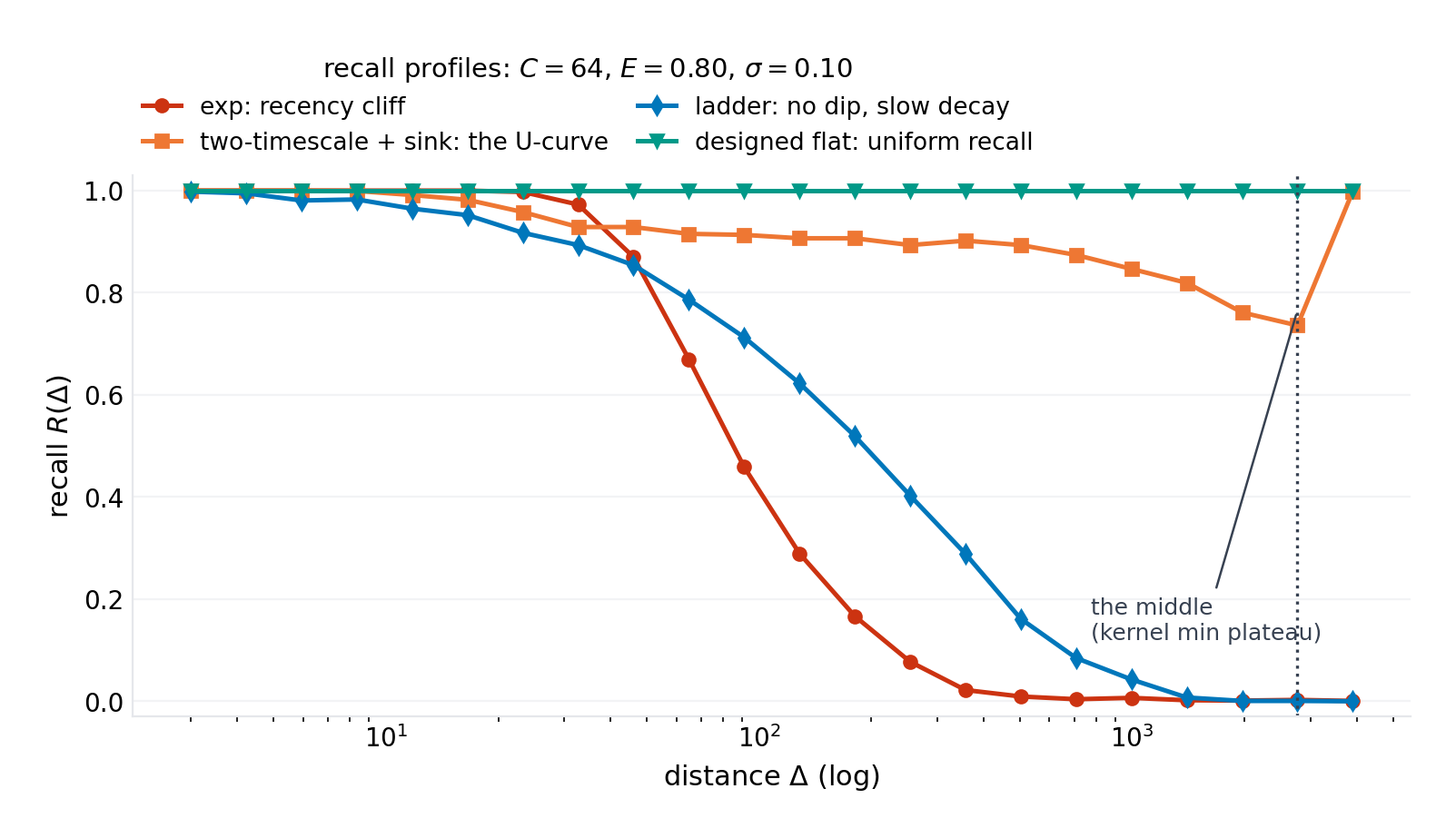 p-030 Recall profiles: cliff, U-curve, and the register’s flat …
The Dissipation Budget Law: Port-Hamiltonian Streams and the Conservation Architecture for Depth
Depth is rented, never owned — every standard residual stream pays norm and gradient rent a normalizer refunds after the fact. The port-Hamiltonian stream makes the guarantees structural: Cayley transport (exactly orthogonal, volume-free to 10^-14 at any step size), metered dissipation (the only volume-contracting channel — expressivity becomes a readable budget line), and ports as the only norm injection. Measured: zero bound violations in 7,200 runs while the control explodes to 10^43; gradient metering through 240 layers; a rank-2 readout at depth 120 scoring 98.1% against the rescued control’s 38.3% (held-out, three seeds). Rev 1.1 answers an external audit — four harness defects fixed, a 13-assertion law-test suite, and an end-to-end training experiment (E6) complete: trained to baseline parity at depth 240 with no normalizer anywhere (97.3% ± 0.3 held-out; spirals-2 open, 57.6%). Rev 1.2 makes the normalization comparison precise — §4.6 states exactly what LayerNorm guarantees (a per-sample layer statistic) and what it does not (any operator bound), reads the trained-model growth numbers as the type distinction made concrete (LN 51.0× vs PH 31.8× at depth 240), and ships the trunk-normalized follow-up ablation flag-gated in the harness. Rev 1.3 registered the real-data evaluation before any run. Rev 1.4 lands the results and reports them straight: the trunk-LN ablation (E6b) took its registered collapse branch — growth pinned at 3.2× but depth-240 accuracy 0.409 ± 0.137 and backward max 2.99×10^8, the §4.6 type distinction demonstrated in the negative direction — and E7a (60/60 CIFAR-10 runs, five families, depths 12/48, NVIDIA L4) returned the mixed verdict its rules encode: accuracy parity within 1.0–1.2 pt, zero PH failures against three trunk-LN collapses, no growth signature at depth 48, 4.4× wall-clock — conservation and stability transfer to real data; the practical-advantage case does not, at this scale. Integrator choice is normalization choice.
The Anchor Law: Ratchets, Floors, and the Minimum Coverage of Agentic Maintenance
How many tests before the agent is safe to let loose — answered with arithmetic instead of volume. The maintenance floor is an exact linear trade between un-anchored noise (quadratic in agent entropy) and frozen legacy error; the ratchet is invisible to behavior anchors (0.8% leak) and pinned only by complexity caps; the stability boundary a*(h) ≈ 1 − κ/h² — required coverage falls quadratically as models improve, the contract an organization can sign with its fleet. Tests are contraction, not verification.
The Lock-In Law: The Phase Transition in Agent Collectives and Its Design Temperature
Groupthink has a formula. A collective of temperature-sampling agents reading a shared board bifurcates at K_c = T(1−λ) — coupling and temperature trade one-for-one, with no useful middle. The locked confidence is a computable fixed point (validated to 0.045%), locking time ∝ ln N·T/(K−K_c), the diversity firewall raises the threshold linearly in fresh-context fraction, and the reset interval that preserves exploration is the locking time. The truncation folklore fails its binary test (1.06×) and is reported as the null it is.
The Green’s Function of Context: Positional Recall as an Inverse Design Problem
Context rot is the Green’s function of a positional kernel nobody designed. The recall profile is the kernel smeared by noise (0.037); the lost-in-the-middle dip lands exactly on its closed form (2771 = 2771); recency windows collapse with load exactly as the extreme-value law computes; and the monotonicity theorem says uniform recall is impossible with timescales alone — it takes a register. The register-plus-slope design buys flat recall at a 90% floor with order resolution priced by the window-order law (0.92 → 0.60 over half a decade to three). The cure for the middle is an inverse problem, minutes of compute.
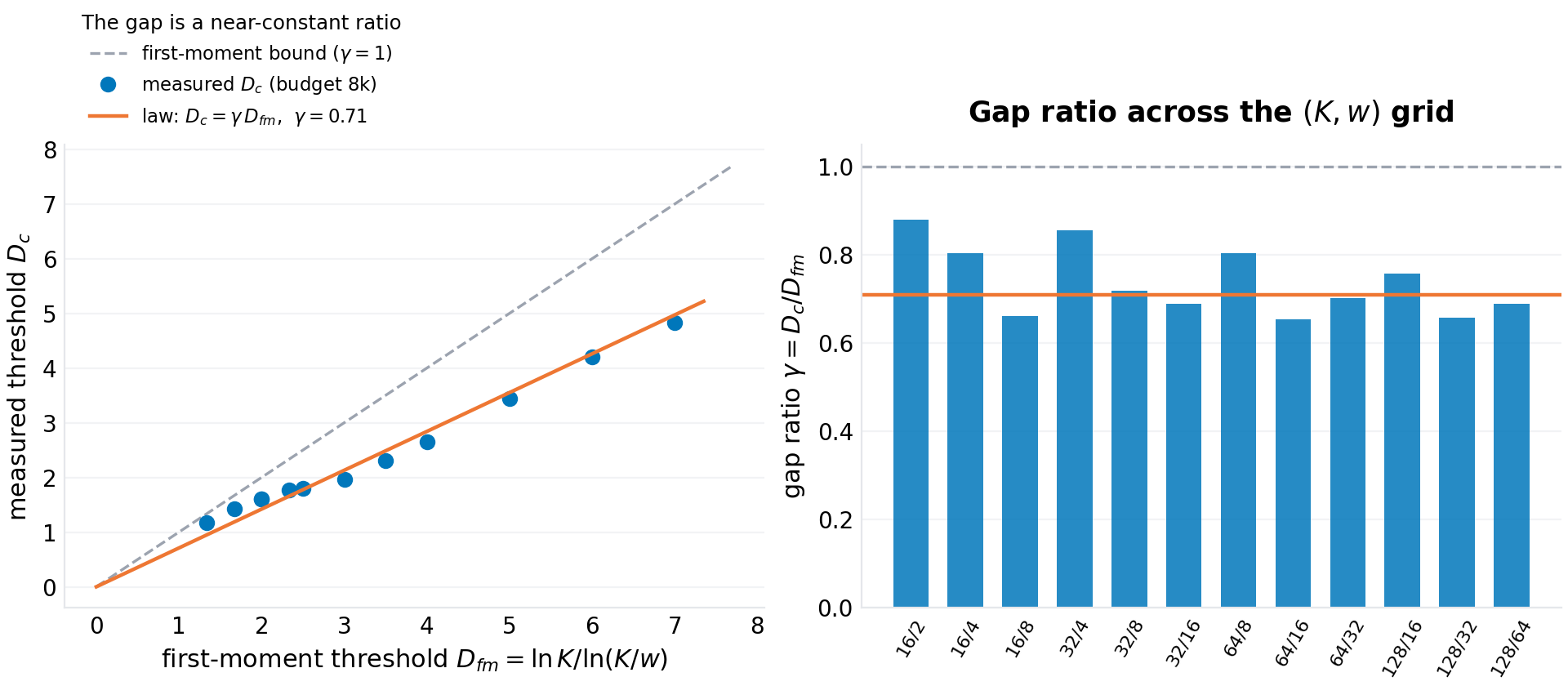 p-024 Measured collapse thresholds against the first-moment bound across the (…
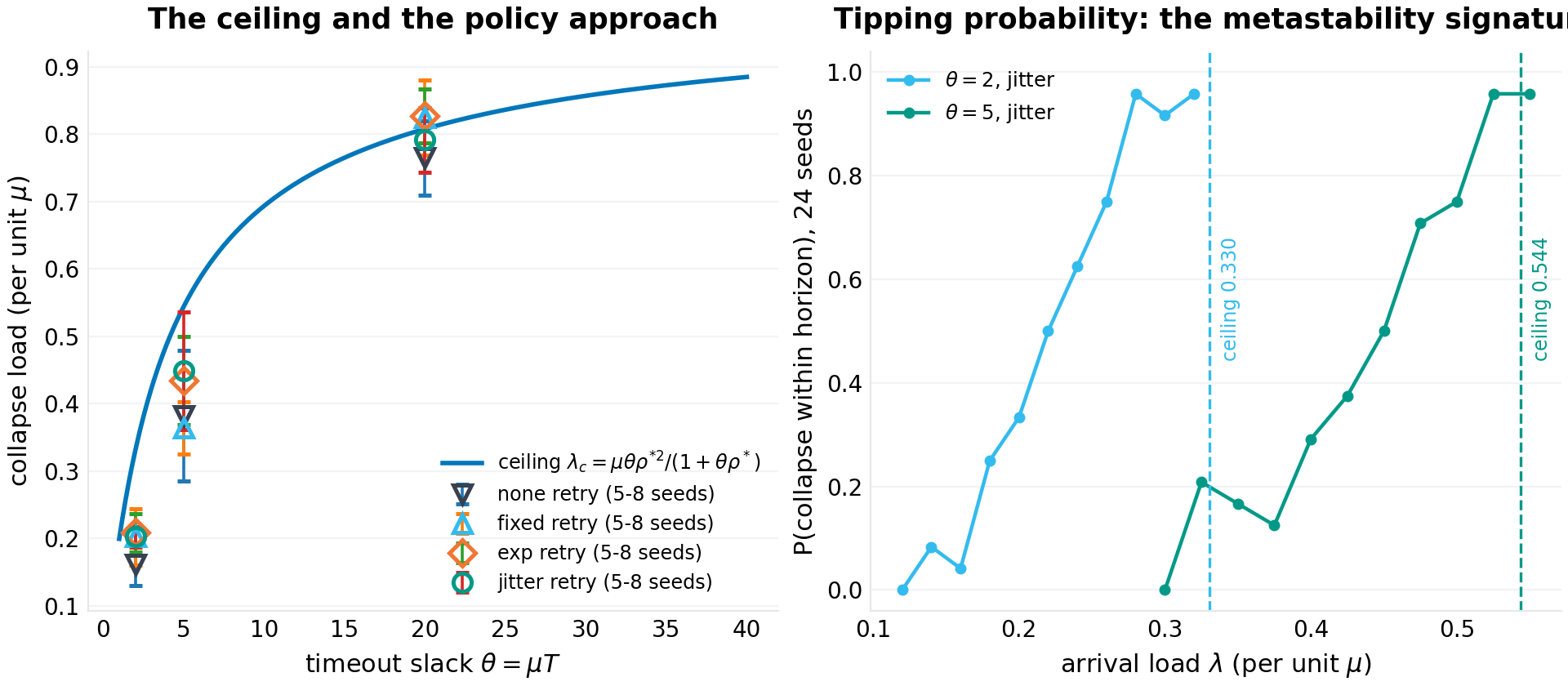 p-025 The collapse ceiling and recovery threshold: hysteresis measured against…
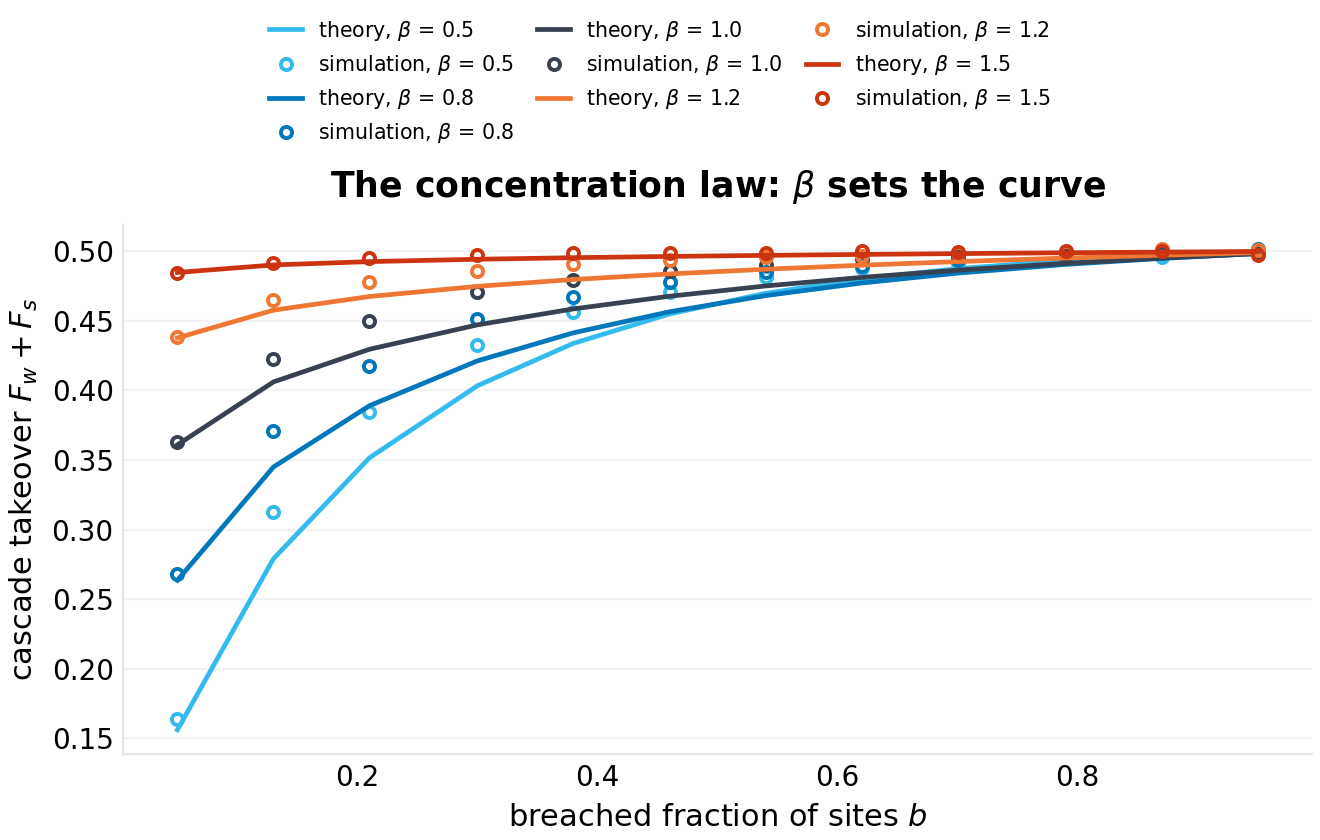 p-026 Spray-channel takeover against password-popularity exponent across pool …
Resolution Collapse: The Satisfiability Threshold of Version-Constrained Dependency Resolution
Dependency resolution is a constraint-satisfaction problem whose density has been rising for two decades, and its failure is a phase transition: below a critical dependency density resolutions exist; above it they cease to exist at all. The first-moment bound Dc ≤ ln K / ln(K/w) (verified exact by brute-force enumeration on the cyclic version space), a measured gap law γ ≈ 0.71 with the constant labeled configuration-specific, the easy–hard–easy cost anatomy, the hardness tax that separates practical budgets from generous ones, the proliferation paradox (version growth at fixed range width is fragility; at proportional width, slow slack), and a growth experiment where crisis-pruning feedback alone pins an ecosystem just below its collapse threshold while the no-feedback arm crosses and installs die permanently. Solver validated against brute force; every figure regenerates from one file.
The Collapse Law: Ceilings, Hysteresis, and the Recovery Threshold for Timeout-Retry Systems
Congestion collapse, priced — and audited. The good steady state of a timeout-retry system dies at a tangency with a closed form (λc = μθρ*²/(1+θρ*)), and the collapsed state survives on the retry budget itself, dying only below λr = μ/R — the maximum and the endpoint of one fixed-point curve, λ = μρ(1−q)/(1−q^R). New in revision 1.1: a derived bistability boundary — the hysteresis loop exists only when (R−1)θ > 2 — and its unlimited-retry limit measured: a collapsed system at 5% load with R = ∞ grows its queue seventeen-fold instead of draining; restart is the only exit. Multi-seed re-measurement (5–24 seeds, error bars): tipping-probability curves that saturate exactly at the ceiling, queue caps inside the horizon shown to eliminate the crater (loop gain q_L·R < 1), and the v1.0 single-seed claims — the −36% backoff resonance, the 81% jitter margin, the horizon "crossing" — withdrawn in Appendix B. The paper now documents its own audit.
The Cascade Law of Credential Reuse: Channels, Concentration, and the Limits of Herd Protection
Every breach is every breach, and now that has arithmetic. An exact blast-radius law for the reuse channel (validated to 0.2%), an exact two-channel decomposition F = Fw + (1−λ)Fs, and a concentration law with a separatrix at password-popularity exponent 1: diverse pools make the cascade dilute (risk grows with the user base), concentrated pools — where real corpora sit — pin it at the backbone from the first breach onward. The defense asymmetry the folklore blurs: lockout friction is the only herd-level lever on the backbone; manager adoption is perfect private protection whose herd threshold is 99.997%. Rate-limit everything that sprays; hand every user a manager; know which is which.
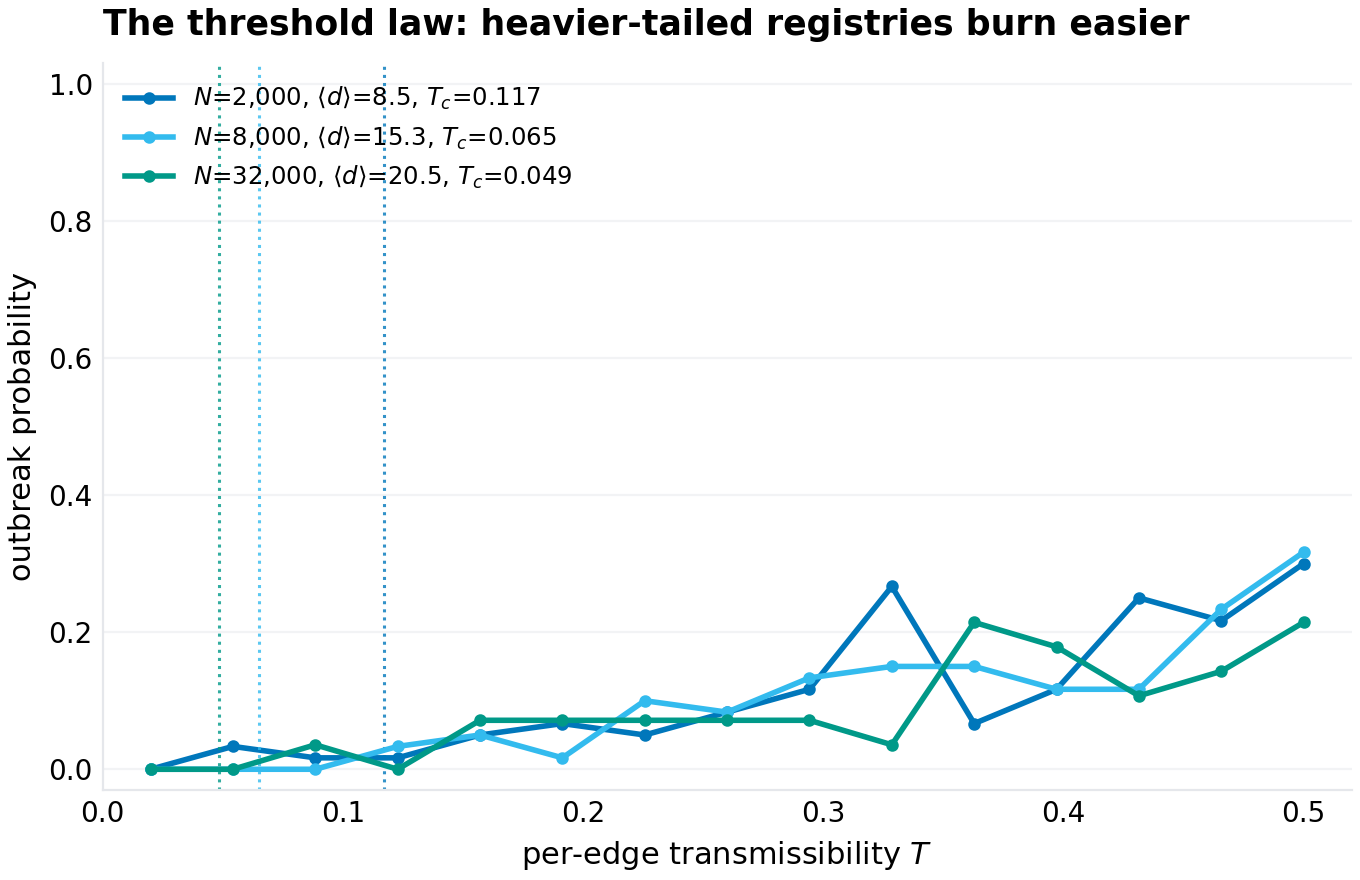 p-021 The compromise phase transition: measured attack prevalence against the …
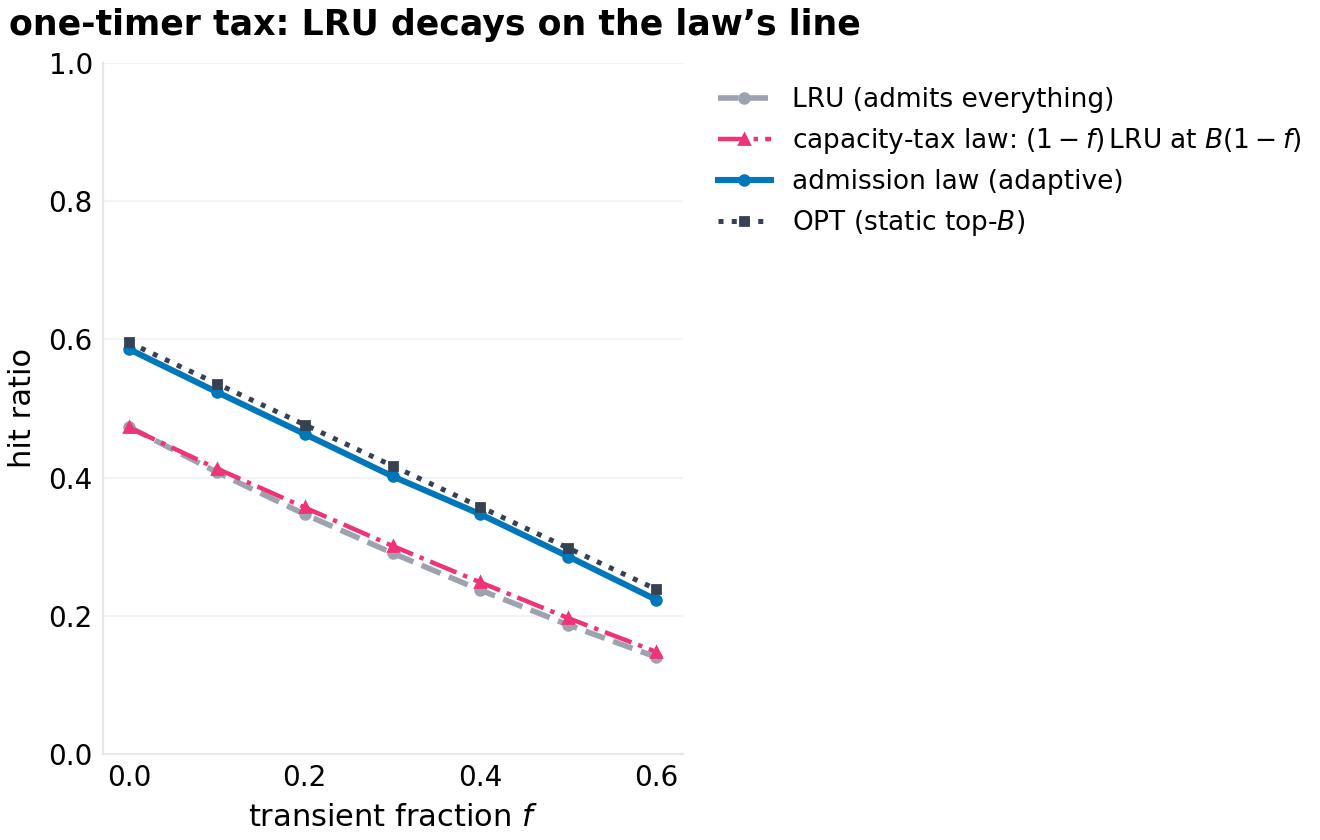 p-022 Transient pollution and the admission threshold across the Zipf sweep…
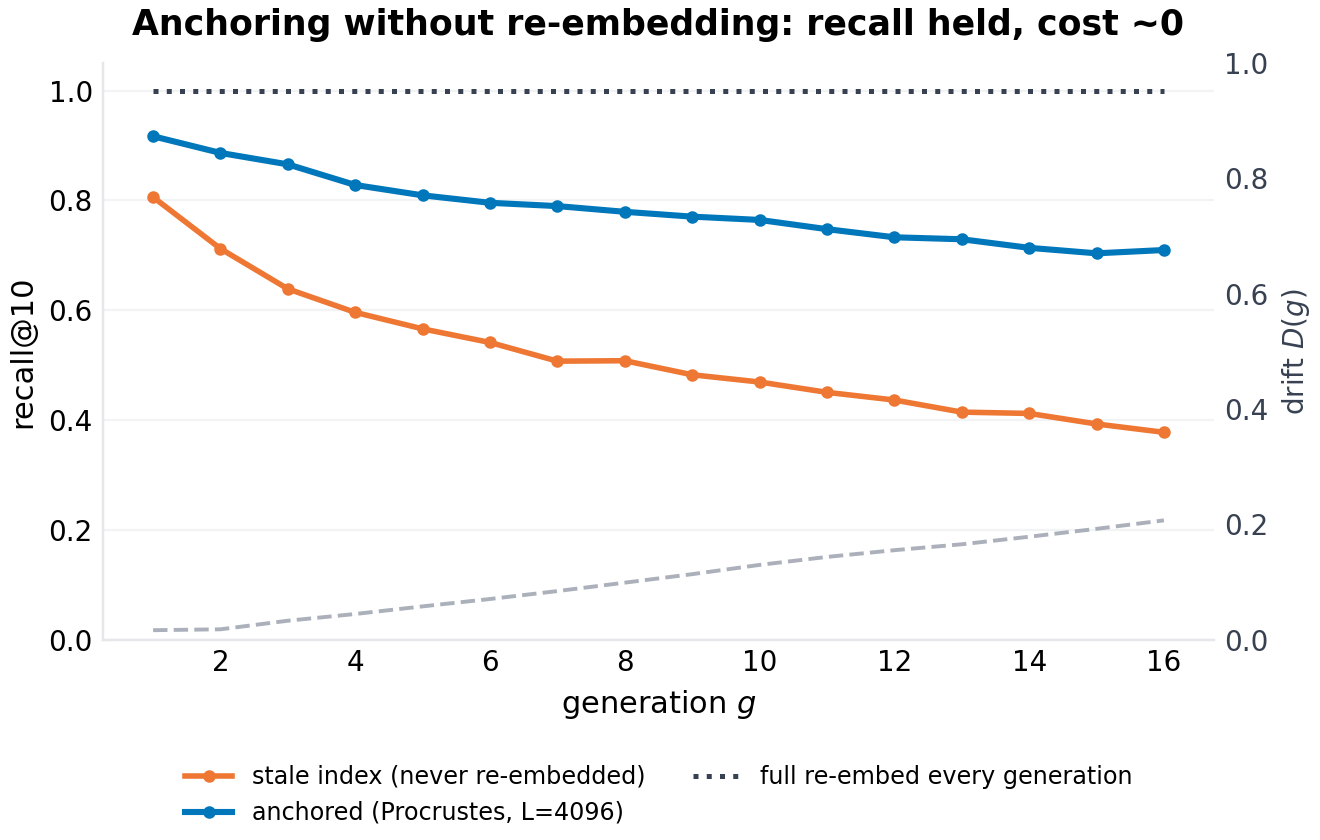 p-023 Recall degradation across re-embedding generations, measured against the…
The Reproduction Number of Code: Epidemic Thresholds for Dependency-Borne Compromise
The program’s quantitative turn: compromised packages as epidemics on the dependency DAG. The spectral threshold everyone computes on registries is exactly zero (nilpotence — it certifies nothing), the correct threshold is the branching law R₀ʲ = T·⟨d⟩, heavy-tailed registries sit in the thresholdless regime where the safe transmissibility zone vanishes with registry size, cascade-aware pinning buys herd immunity at one-eighth the random budget, and the registry yank has a half-life of two cascade steps. Derived, validated across 28 configurations, reproducible from one file.
The Admission Law: A Closed-Form Threshold for Cache Admission under Zipf Demand with Transients
The folklore of admission filters (TinyLFU doors, probation segments), written as arithmetic: τ* = (1−f)W / (H·Bα) — the threshold tracks the stable-evidence volume, flat demand demands severe doors, and the door legally disables itself when capacity covers the head. The capacity tax prices the unfiltered cache at f/(1−f) of its memory; the law’s argmax matches the closed form within 1% where the choice matters, and gains over LRU reach 137% at the flat-and-dirty corner. Four measurements, one line of arithmetic, the door.
Generation Loss: A Drift Law for Continually Re-embedded Vector Corpora
Every vector index goes stale between encoder upgrades, and nobody has the law: D(g) = 1−λg with λ the product of an isometry channel (dimension-mercied into harmlessness and removable exactly by a Procrustes landmark panel) and a distortion channel (dimension-free, un-alignable, the entire real cost of churn). Validated to three decimals; anchored stale vectors hold nearly double the recall at a rounding error of re-embedding cost. Revision 1.1: the draft's “L ≈ 8d” landmark constant is withdrawn and replaced by a derived estimation theorem — the panel budget is a four-factor law (accumulated distortion, panel coverage, estimator class, tolerance) whose knee-migration experiments (F6/F7) track within 11%; an undersized panel is shown to be worse than no panel at all. The re-embed calendar, replaced by two probes and one matrix solve.
The Revocation Protocol: Consent Withdrawal as a Propagation Guarantee
“You can withdraw anytime” is the most repeated promise in software, and withdrawal is a local event with no propagation semantics: the token dies at the first hop while the data already exported, resold, and folded into models keeps working. Grant objects with lineage, revocation events with coverage semantics, signed receipts, re-attestation cycles that make consent re-earned rather than remembered, canary audits, and a liability ladder where silence becomes evidence — the certificate ecosystem’s short-lived-cert lesson, applied to the largest class of unkept promises in software.
Epistemic Half-Life: Truth Decay Semantics for Stored Data
Food has sell-by dates, markets hard-code stale-quote bounds, and the database — the artifact that stores more facts than all of them — models no perishability at all. Decay functions with half-life families, confidence-aware queries, an honest join algebra where the stale join inherits the worst of its inputs, half-lives estimated from the organization’s own change streams, budgeted verification scheduling, and staleness as an outage class: truth decay, specified.
Dormancy Engineering: Software Design for the Long Sleep
Always-on proves systems by exercising them; archives preserve sources for historians; between them sits the regime nobody engineers — software that must work after years of not running. Dormancy classes with declared wake bounds, the environment-drift ledger (the actuarial table of the world’s churn), the wake-probe ladder from checksums to germination tests, the exercise calendar, and the readiness contract: the seed vault’s discipline, built for the drawer the boot stick is rotting in.
Blast Radius Engineering: Personal Reliability Engineering for Correlated Failure
SRE’s deepest lesson is that failures correlate through shared roots — and no discipline maps the correlations of the individual’s stack: one identity, one phone number, one cloud, one email reset path, one person. The personal dependency graph with eight correlation classes, weighted blast radii, composite-availability arithmetic that tells the truth about marketing’s nines, budgeted decorrelation placement, the failure weather report, and the annual kill-one-root drill: Markowitz’s mathematics, aimed at the household.
The Complexity Ledger: Design as Relocation, Not Reduction
Every discipline that moves matter has an accounting discipline; the one that moves complexity has folklore. Tesler's law of conservation of complexity — fifty years quoted, never once operationalized — becomes a falsifiable theory over five sinks with field-measurable proxies (code, interaction, operation, documentation, deferral), double-entry relocation records that refuse one-legged claims of reduction, complexity budgets with reconciliation at release cadence, and a consent column separating trades from externalities. The waterbed signatures in compiler flags, ticket-migration signatures after UI "simplifications," and documentation-volume compensation after API redesigns are the theory's testable predictions.
Delegated Operation: Software for the Body with More Than One Owner
The single-principal assumption — one account, one human, present and able — fails the 53 million unpaid family caregivers who operate a parent's phone, bank, pharmacy, and email through shared passwords and video-call screen shares that security teams classify as abuse. We specify the operator principal: capability bundles instead of credential handover, a graduated autonomy ladder (observe → advise → co-act → act → break-glass), grants that are purpose-scoped, time-boxed, and device-bound, audit trails the primary owns, drift detection aimed at the operator, and succession semantics ending in an estate mode rather than a suspension email.
Modality Failover: Cross-Sensory Redundancy for Critical Software
Alerting's hidden single point of failure is the human sensory channel: the deaf user's intact smoke alarm, the pocketed phone at 3 a.m., the clinical alarm-fatigue catastrophe — channel death treated as the environment's problem. We specify RAID for the senses: platform-granted criticality classes (advisory / action / life-safety), a local private capability profile of live channels, k-of-n delivery, acknowledgment-gated escalation across modalities, devices, and finally people, channel-health probing, and an antifatigue governor. CAP standardized the message; this is the missing receiving layer.
The Uncertain Document: Propagating Uncertainty Through Everyday Software
Metrology solved error propagation a century ago (GUM); the office, the hospital, and the ministry still run on bare floats whose point-estimate form made the austerity-spreadsheet error invisible. We specify the quant — {point, distribution, provenance, confidence, units} — as the document's native numeric type, with tiered propagation (interval arithmetic, Monte Carlo, GUM's law), a calibrated display contract built on the natural-frequencies evidence, an assumption registry that ages, uncertainty that survives copy-paste and APIs, and the calibration ledger: the first instrument that lets an organization learn its own estimation bias.
The Defaults Ledger: Governing the Strongest Force in Software
Defaults produce the largest measured effect sizes in behavioral science — organ-donation consent from 4% to 99% between neighboring countries, a $20B/year market price for one search box's placement — and the act of setting one is recorded nowhere. We specify the civic layer: machine-readable defaults manifests with provenance and changed-from, update-time diff and drift notification, a portable personal override registry, household and third-party negotiation layers (importable default packs), default impact assessments above exposure thresholds, and procurement-grade defaults bills of materials. Defaults are legislation nobody voted on; this is the parliamentary record.
The Afterlife of Devices: An Architecture for Vendor-Death Resilience
Connected devices have physical lifetimes of a decade and corporate lifetimes of a few years, and the crossing is undesigned: Insteon darkened hubs overnight in 2023, Revolv was bricked on a published schedule in 2016. We specify succession-ready devices — a lifecycle state machine with an explicit succession transition, a device succession manifest, escrowed continuity released by verifiable dead-hand triggers (bankruptcy filings, certificate expiry, renewal silence), a threshold key-succession ceremony, a degradation ladder, and a hardware-guaranteed fossil mode. Every component exists in an adjacent industry; the composition does not exist anywhere.
Circadian Orchestration: Team Scheduling on Human Biological Time
Collaborative calendars model availability — free or busy — and nothing else, while human performance varies by circadian phase with a population spread of four to six hours. We specify circadian orchestration: a private phase state (questionnaire-grade estimation, optional wearable calibration), circadian cost functions from the two-process model of sleep regulation, fairness-constrained meeting placement with minimax burden bounds, and the golden overlap — all under a privacy-first architecture where only binned cost surfaces leave the client and no individual's phase is ever transmitted. The evidence grades PARTIAL at components, STRONG at composition.
The Bus Factor Protocol: Succession Governance for Open-Source Package Registries
Registries govern code identity — names, signing, provenance — but not maintainership continuity, so the supply chain's load-bearing packages decay into abandonment by default, and every catastrophic governance failure of the last decade began in the succession gap: left-pad, event-stream, colors, and the 2024 xz-utils backdoor, which was a succession attack executed through a tired maintainer's private handover. We specify the bus factor protocol: an abandonment state machine, succession policy as code, a dormancy escalation ladder ending in a narrow security-hold, an anti-xz trust-elevation ladder (co-signed, delay-locked early releases), dead-hand transfers, community takeover with tenure-in-graph vouching, and a public continuity ledger.
Model Extinction: Behavioral Conservation for the Age of Disposable AI
We preserve web pages, source code, films, and seeds — but not the behavior of deployed AI models, the fastest-dying artifact class in software history. Same-name drift, fine-tune orphaning, unreproducible science, and silent product breakage are one uncounted extinction event. We specify behavioral conservation: the behavioral fingerprint (stratified, anchor-linked eval suites with confidence regions, including consumer-contributed regression strata), equivalence testing for replacements (TOST-based deprecation audits), an IUCN-style extinction registry, inference-time provenance tokens, archival access tiers, and enforceable deprecation contracts. Conserve the observable, not the substrate.
Degradation Contracts: Specifying and Enforcing How Software Behaves Under Pressure
Every piece of software has two behaviors: the one it exhibits when resources are abundant, and the one under pressure. The first is engineered — specified, tested, monitored, budgeted. The second is emergent: accidental, untested, invisible. We propose degradation contracts: a declarative formalism (fidelity ladders per feature, safe shedding orders, hysteresis and recovery semantics, floor invariants) and a pressure broker that measures pressure, mediates directives, and audits compliance into a queryable ledger. The payoffs compound in the AI era, where quality is already a runtime variable negotiated invisibly; contracts make that negotiation inspectable and fair.
Provenance-Native Storage: The File System as a Causal Ledger
Every file is an amnesiac: it knows its size and mtime, and has forgotten who created it, from what inputs, over which network origin. PASS proved automatic file provenance feasible in 2006; nothing shipped. The barriers have expired: eBPF/EndpointSecurity/ETW capture substrates, content-addressed compaction, local analytical engines, and C2PA's market education. This paper specifies the causal event ledger, the application transform contract, the query algebra, and the retention semantics that treat forgetting as a feature — the trust infrastructure the AI era just made mandatory.
The Attention Scheduler: Interruption Economics as an Operating System Problem
OSes schedule processors, memory, and network with fifty years of theory; attention is scheduled by a DND toggle and an adversarial engagement economy at a measured cost of ~23 minutes of resumption per interruption, unrecorded. We specify the attention scheduler: interruption-cost models, admission control with deferral queues, breakpoint-timed dispatch, per-app budgets with honesty pricing, urgent-class bounded latency, starvation freedom, and an attention ledger. Closed platform features are approaching this system without the theory; the paper supplies the semantics first.
The Intermittent Compute Fabric: One Machine Across Many Devices
The median user owns five to eight devices that behave as islands joined only by cloud meters. The offloading research line died in 2012 for reasons that have quietly expired: mesh VPNs solved reachability, WASM and containers solved portability, device identity is solved, and distributed local AI is the first workload in a generation that needs cross-device placement. We specify the fabric: a scheduler that treats sleep and partition as inputs, a capability-delegation protocol, partition-tolerant task semantics, and an ambient CRDT state layer — one machine across many devices, owned.
The Personal Event Bus: User-Owned Middleware for Ambient Digital-Life Events
Phones receive the most valuable structured data of a person's life — payment events, receipts, gate changes, renewals — and throw it away before it can be kept. The personal event bus is user-owned middleware that captures ambient events, stores them under user control, and projects permissioned views to consuming applications: the missing skeleton of personal data infrastructure, specified formally.
Consumer Entitlements as Dead Capital
Billions per year in statutory and contractual rights — compensation regimes, refund windows, class settlements — go unclaimed because rights are invisible, perishable, and unpriced. The personal entitlement engine treats a right as a machine-readable object with detection, valuation, and execution semantics, converting dead capital to live capital for the holder.
The n=1 Cost-of-Living Index
Official inflation is an average over a nation that matches no individual. This paper specifies the methodology for a statistically defensible personal price index — matched-model chaining, quality adjustment for shrinkflation, Bayesian shrinkage to official indices, uncertainty bands — and the local-first multi-source software that would compute it from a person's own receipts.
Cite
30 entriesBibTeX for every paper. Each entry cites the PDF (the typeset, canonical form); the markdown source lives at the same path in the repository.
Show BibTeX (30 entries)
@techreport{prick2026p001,
  title       = {The Personal Event Bus: User-Owned Middleware for Ambient Digital-Life Events},
  author      = {p-rick research program},
  institution = {p-rick},
  type        = {Working paper},
  number      = {P-001},
  series      = {Series I: User-owned data},
  year        = {2026},
  month       = oct,
  url         = {https://srivtx.github.io/p-rick/pdfs/p-001.pdf}
}

@techreport{prick2026p002,
  title       = {Consumer Entitlements as Dead Capital},
  author      = {p-rick research program},
  institution = {p-rick},
  type        = {Working paper},
  number      = {P-002},
  series      = {Series I: User-owned data},
  year        = {2026},
  month       = oct,
  url         = {https://srivtx.github.io/p-rick/pdfs/p-002.pdf}
}

@techreport{prick2026p003,
  title       = {The n=1 Cost-of-Living Index},
  author      = {p-rick research program},
  institution = {p-rick},
  type        = {Working paper},
  number      = {P-003},
  series      = {Series I: User-owned data},
  year        = {2026},
  month       = oct,
  url         = {https://srivtx.github.io/p-rick/pdfs/p-003.pdf}
}

@techreport{prick2026p004,
  title       = {Degradation Contracts: Specifying and Enforcing How Software Behaves Under Pressure},
  author      = {p-rick research program},
  institution = {p-rick},
  type        = {Working paper},
  number      = {P-004},
  series      = {Series II: Systems},
  year        = {2026},
  month       = oct,
  url         = {https://srivtx.github.io/p-rick/pdfs/p-004.pdf}
}

@techreport{prick2026p005,
  title       = {Provenance-Native Storage: The File System as a Causal Ledger},
  author      = {p-rick research program},
  institution = {p-rick},
  type        = {Working paper},
  number      = {P-005},
  series      = {Series II: Systems},
  year        = {2026},
  month       = oct,
  url         = {https://srivtx.github.io/p-rick/pdfs/p-005.pdf}
}

@techreport{prick2026p006,
  title       = {The Attention Scheduler: Interruption Economics as an Operating System Problem},
  author      = {p-rick research program},
  institution = {p-rick},
  type        = {Working paper},
  number      = {P-006},
  series      = {Series II: Systems},
  year        = {2026},
  month       = oct,
  url         = {https://srivtx.github.io/p-rick/pdfs/p-006.pdf}
}

@techreport{prick2026p007,
  title       = {The Intermittent Compute Fabric: One Machine Across Many Devices},
  author      = {p-rick research program},
  institution = {p-rick},
  type        = {Working paper},
  number      = {P-007},
  series      = {Series II: Systems},
  year        = {2026},
  month       = oct,
  url         = {https://srivtx.github.io/p-rick/pdfs/p-007.pdf}
}

@techreport{prick2026p008,
  title       = {The Afterlife of Devices: An Architecture for Vendor-Death Resilience},
  author      = {p-rick research program},
  institution = {p-rick},
  type        = {Working paper},
  number      = {P-008},
  series      = {Series III: Continuity},
  year        = {2026},
  month       = oct,
  url         = {https://srivtx.github.io/p-rick/pdfs/p-008.pdf}
}

@techreport{prick2026p009,
  title       = {Circadian Orchestration: Team Scheduling on Human Biological Time},
  author      = {p-rick research program},
  institution = {p-rick},
  type        = {Working paper},
  number      = {P-009},
  series      = {Series III: Continuity},
  year        = {2026},
  month       = oct,
  url         = {https://srivtx.github.io/p-rick/pdfs/p-009.pdf}
}

@techreport{prick2026p010,
  title       = {The Bus Factor Protocol: Succession Governance for Open-Source Package Registries},
  author      = {p-rick research program},
  institution = {p-rick},
  type        = {Working paper},
  number      = {P-010},
  series      = {Series III: Continuity},
  year        = {2026},
  month       = oct,
  url         = {https://srivtx.github.io/p-rick/pdfs/p-010.pdf}
}

@techreport{prick2026p011,
  title       = {Model Extinction: Behavioral Conservation for the Age of Disposable AI},
  author      = {p-rick research program},
  institution = {p-rick},
  type        = {Working paper},
  number      = {P-011},
  series      = {Series III: Continuity},
  year        = {2026},
  month       = oct,
  url         = {https://srivtx.github.io/p-rick/pdfs/p-011.pdf}
}

@techreport{prick2026p012,
  title       = {The Complexity Ledger: Design as Relocation, Not Reduction},
  author      = {p-rick research program},
  institution = {p-rick},
  type        = {Working paper},
  number      = {P-012},
  series      = {Series IV: Assumptions},
  year        = {2026},
  month       = oct,
  url         = {https://srivtx.github.io/p-rick/pdfs/p-012.pdf}
}

@techreport{prick2026p013,
  title       = {Delegated Operation: Software for the Body with More Than One Owner},
  author      = {p-rick research program},
  institution = {p-rick},
  type        = {Working paper},
  number      = {P-013},
  series      = {Series IV: Assumptions},
  year        = {2026},
  month       = oct,
  url         = {https://srivtx.github.io/p-rick/pdfs/p-013.pdf}
}

@techreport{prick2026p014,
  title       = {Modality Failover: Cross-Sensory Redundancy for Critical Software},
  author      = {p-rick research program},
  institution = {p-rick},
  type        = {Working paper},
  number      = {P-014},
  series      = {Series IV: Assumptions},
  year        = {2026},
  month       = oct,
  url         = {https://srivtx.github.io/p-rick/pdfs/p-014.pdf}
}

@techreport{prick2026p015,
  title       = {The Uncertain Document: Propagating Uncertainty Through Everyday Software},
  author      = {p-rick research program},
  institution = {p-rick},
  type        = {Working paper},
  number      = {P-015},
  series      = {Series IV: Assumptions},
  year        = {2026},
  month       = oct,
  url         = {https://srivtx.github.io/p-rick/pdfs/p-015.pdf}
}

@techreport{prick2026p016,
  title       = {The Defaults Ledger: Governing the Strongest Force in Software},
  author      = {p-rick research program},
  institution = {p-rick},
  type        = {Working paper},
  number      = {P-016},
  series      = {Series IV: Assumptions},
  year        = {2026},
  month       = oct,
  url         = {https://srivtx.github.io/p-rick/pdfs/p-016.pdf}
}

@techreport{prick2026p017,
  title       = {The Revocation Protocol: Consent Withdrawal as a Propagation Guarantee},
  author      = {p-rick research program},
  institution = {p-rick},
  type        = {Working paper},
  number      = {P-017},
  series      = {Series V: Promises},
  year        = {2026},
  month       = oct,
  url         = {https://srivtx.github.io/p-rick/pdfs/p-017.pdf}
}

@techreport{prick2026p018,
  title       = {Epistemic Half-Life: Truth Decay Semantics for Stored Data},
  author      = {p-rick research program},
  institution = {p-rick},
  type        = {Working paper},
  number      = {P-018},
  series      = {Series V: Promises},
  year        = {2026},
  month       = oct,
  url         = {https://srivtx.github.io/p-rick/pdfs/p-018.pdf}
}

@techreport{prick2026p019,
  title       = {Dormancy Engineering: Software Design for the Long Sleep},
  author      = {p-rick research program},
  institution = {p-rick},
  type        = {Working paper},
  number      = {P-019},
  series      = {Series V: Promises},
  year        = {2026},
  month       = oct,
  url         = {https://srivtx.github.io/p-rick/pdfs/p-019.pdf}
}

@techreport{prick2026p020,
  title       = {Blast Radius Engineering: Personal Reliability Engineering for Correlated Failure},
  author      = {p-rick research program},
  institution = {p-rick},
  type        = {Working paper},
  number      = {P-020},
  series      = {Series V: Promises},
  year        = {2026},
  month       = oct,
  url         = {https://srivtx.github.io/p-rick/pdfs/p-020.pdf}
}

@techreport{prick2026p021,
  title       = {The Reproduction Number of Code: Epidemic Thresholds for Dependency-Borne Compromise},
  author      = {p-rick research program},
  institution = {p-rick},
  type        = {Working paper},
  number      = {P-021},
  series      = {Series VI: Laws},
  year        = {2026},
  month       = oct,
  url         = {https://srivtx.github.io/p-rick/pdfs/p-021.pdf}
}

@techreport{prick2026p022,
  title       = {The Admission Law: A Closed-Form Threshold for Cache Admission under Zipf Demand with Transients},
  author      = {p-rick research program},
  institution = {p-rick},
  type        = {Working paper},
  number      = {P-022},
  series      = {Series VI: Laws},
  year        = {2026},
  month       = oct,
  url         = {https://srivtx.github.io/p-rick/pdfs/p-022.pdf}
}

@techreport{prick2026p023,
  title       = {Generation Loss: A Drift Law for Continually Re-embedded Vector Corpora},
  author      = {p-rick research program},
  institution = {p-rick},
  type        = {Working paper},
  number      = {P-023},
  series      = {Series VI: Laws},
  year        = {2026},
  month       = oct,
  url         = {https://srivtx.github.io/p-rick/pdfs/p-023.pdf}
}

@techreport{prick2026p024,
  title       = {Resolution Collapse: The Satisfiability Threshold of Version-Constrained Dependency Resolution},
  author      = {p-rick research program},
  institution = {p-rick},
  type        = {Working paper},
  number      = {P-024},
  series      = {Series VII: Collapse},
  year        = {2026},
  month       = oct,
  url         = {https://srivtx.github.io/p-rick/pdfs/p-024.pdf}
}

@techreport{prick2026p025,
  title       = {The Collapse Law: Ceilings, Hysteresis, and the Recovery Threshold for Timeout-Retry Systems},
  author      = {p-rick research program},
  institution = {p-rick},
  type        = {Working paper},
  number      = {P-025},
  series      = {Series VII: Collapse},
  year        = {2026},
  month       = oct,
  url         = {https://srivtx.github.io/p-rick/pdfs/p-025.pdf}
}

@techreport{prick2026p026,
  title       = {The Cascade Law of Credential Reuse: Channels, Concentration, and the Limits of Herd Protection},
  author      = {p-rick research program},
  institution = {p-rick},
  type        = {Working paper},
  number      = {P-026},
  series      = {Series VII: Collapse},
  year        = {2026},
  month       = oct,
  url         = {https://srivtx.github.io/p-rick/pdfs/p-026.pdf}
}

@techreport{prick2026p027,
  title       = {The Dissipation Budget Law: Port-Hamiltonian Streams and the Conservation Architecture for Depth},
  author      = {p-rick research program},
  institution = {p-rick},
  type        = {Working paper},
  number      = {P-027},
  series      = {Series VIII: Machinery},
  year        = {2026},
  month       = oct,
  url         = {https://srivtx.github.io/p-rick/pdfs/p-027.pdf}
}

@techreport{prick2026p028,
  title       = {The Anchor Law: Ratchets, Floors, and the Minimum Coverage of Agentic Maintenance},
  author      = {p-rick research program},
  institution = {p-rick},
  type        = {Working paper},
  number      = {P-028},
  series      = {Series VIII: Machinery},
  year        = {2026},
  month       = oct,
  url         = {https://srivtx.github.io/p-rick/pdfs/p-028.pdf}
}

@techreport{prick2026p029,
  title       = {The Lock-In Law: The Phase Transition in Agent Collectives and Its Design Temperature},
  author      = {p-rick research program},
  institution = {p-rick},
  type        = {Working paper},
  number      = {P-029},
  series      = {Series VIII: Machinery},
  year        = {2026},
  month       = oct,
  url         = {https://srivtx.github.io/p-rick/pdfs/p-029.pdf}
}

@techreport{prick2026p030,
  title       = {The Green's Function of Context: Positional Recall as an Inverse Design Problem},
  author      = {p-rick research program},
  institution = {p-rick},
  type        = {Working paper},
  number      = {P-030},
  series      = {Series VIII: Machinery},
  year        = {2026},
  month       = oct,
  url         = {https://srivtx.github.io/p-rick/pdfs/p-030.pdf}
}