02 · Sound to signals to bits
In the story: the first reply from the buds was a row of numbers like
AA 0D 00 00 06 81 …. To read it we need to know what a byte is, why it’s written in hex, and why06 81means 0x8106. This chapter builds that from air pressure upwards.
Everything Earshot does is moving numbers around. Before we can read a protocol, we need to know what a number is inside a machine, starting from the air in your ear.
Sound is pressure
Sound is air molecules being pushed together and pulled apart, very quickly. A speaker cone moves back and forth, and that creates regions of slightly higher and slightly lower pressure that travel outwards at about 343 m/s.
- How often the pressure swings per second is the frequency, measured in hertz (Hz). We hear roughly 20 Hz to 20 000 Hz.
- How far it swings is the amplitude, heard as loudness.
A microphone has a thin membrane that moves with those pressure changes, and the movement is turned into a tiny voltage that rises and falls in step. That voltage is an analogue signal: a continuous copy of the sound.
Sampling and quantising
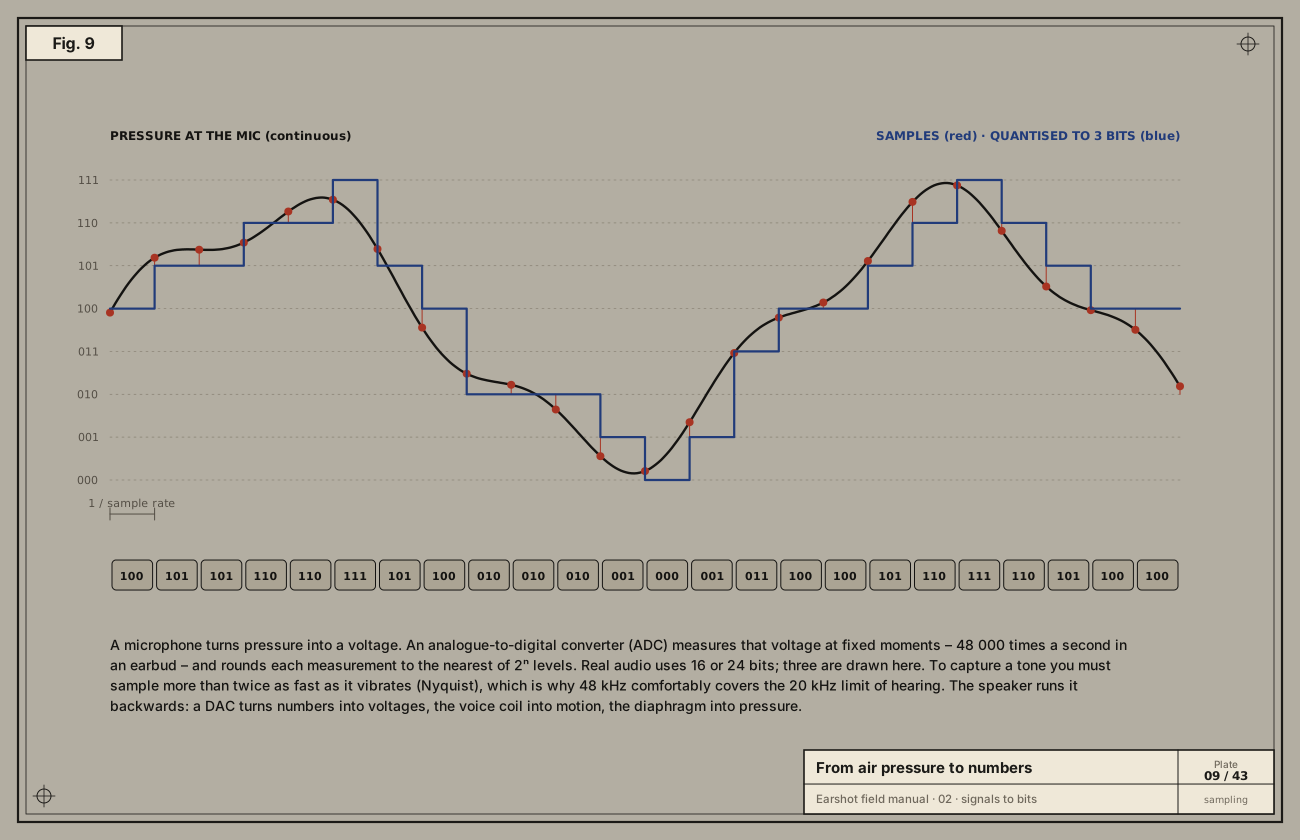
A computer can’t store “a continuous voltage”, only numbers. An analogue-to-digital converter (ADC) does two things:
- Sampling: it measures the voltage at fixed intervals, typically 48 000 times per second (48 kHz) in earbuds. The Nyquist theorem says that to capture a frequency you must sample more than twice as fast as it, so 48 kHz covers everything up to 24 kHz, beyond human hearing.
- Quantising: it rounds each measurement to the nearest of a fixed set of levels. n bits give 2ⁿ levels: 3 bits give 8 (as drawn), 16 bits give 65 536, and 24 bits over 16 million. The rounding error is quantisation noise; more bits make it quieter.
Going back out, a digital-to-analogue converter (DAC) turns numbers into a voltage, an amplifier strengthens it, and the voice coil turns it into motion (chapter 01).
Uncompressed CD-quality stereo is 44 100 samples × 16 bits × 2 channels ≈ 1.4 Mbit/s. That’s far more than Bluetooth carries reliably, which is why audio is compressed by a codec before it is sent (chapter 04).
A voltage becomes a bit
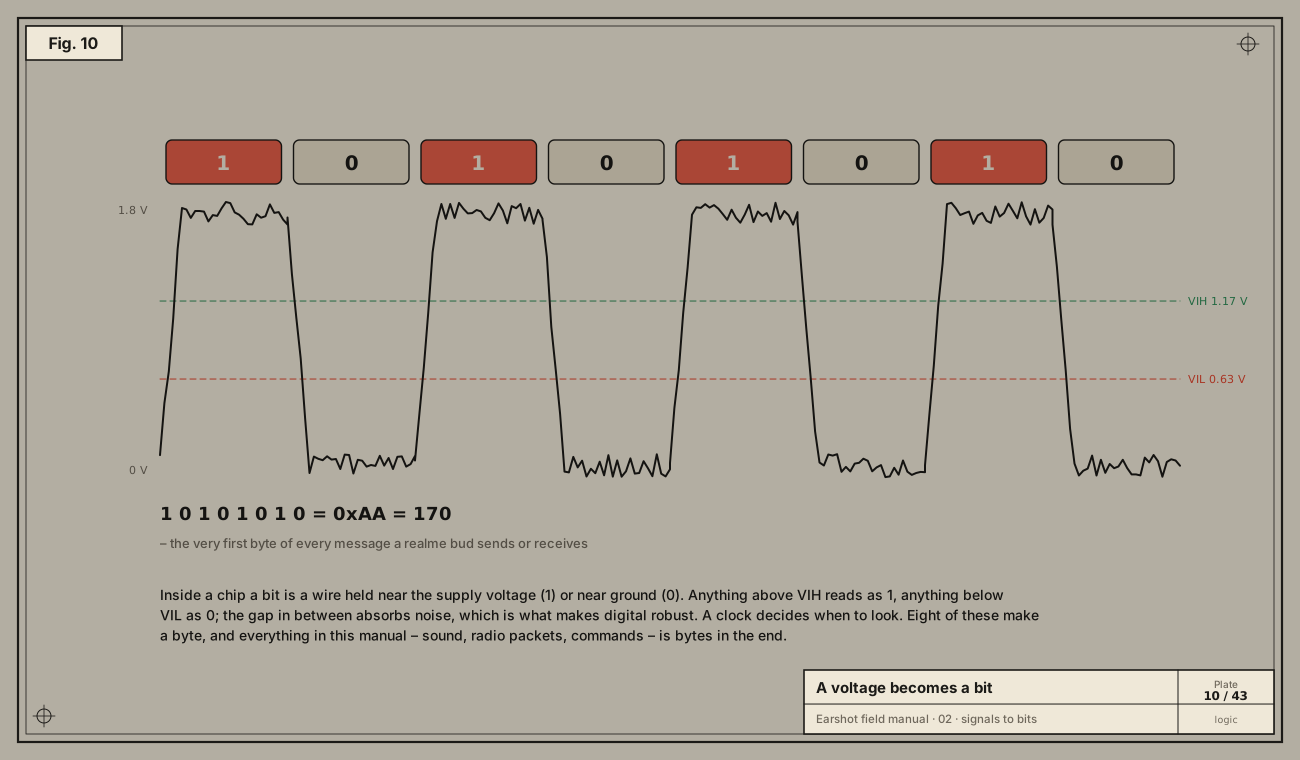
Inside digital chips a wire is either near the supply voltage or near 0 V.
- In a modern low-power chip the supply might be 1.8 V.
- The chip promises to read anything above VIH (about 65 % of supply) as 1, and anything below VIL (about 35 %) as 0.
- The gap between them is a safety margin: noise can’t flip a bit. That margin is why digital electronics are reliable.
A clock decides when to look at the wire. One look, one bit (binary digit).
The waveform in the plate is 1 0 1 0 1 0 1 0, the byte 0xAA. It’s the first byte of every message a realme bud sends or receives.
The byte
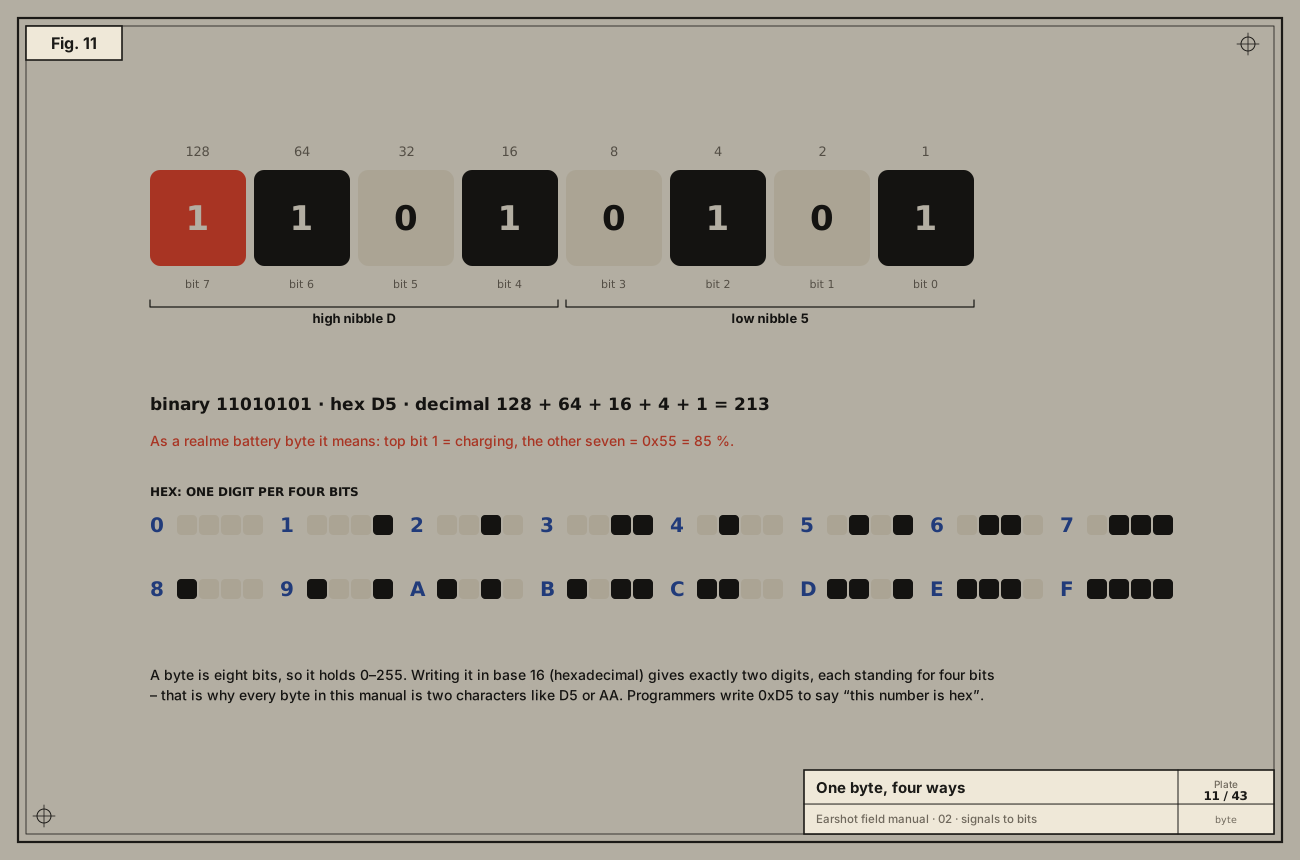
Eight bits make a byte. Each position is worth a power of two, from 128 down to 1. Add the positions holding a 1 and you get its value, 0 to 255.
Eight binary digits are tedious to write, so we use hexadecimal (base 16): 0–9 then A–F (A = 10 … F = 15). One hex digit is exactly four bits, so a byte is always exactly two hex digits.
binary  1101 0101
hex       D    5     → 0xD5
decimal 128 + 64 + 16 + 4 + 1 = 213
The 0x prefix means “this is hex”. In this manual every byte is written as two hex digits: AA, 0D, D5.
Try it:
python3 -c "print(0xD5, bin(0xD5), hex(213))"
Numbers bigger than a byte: endianness
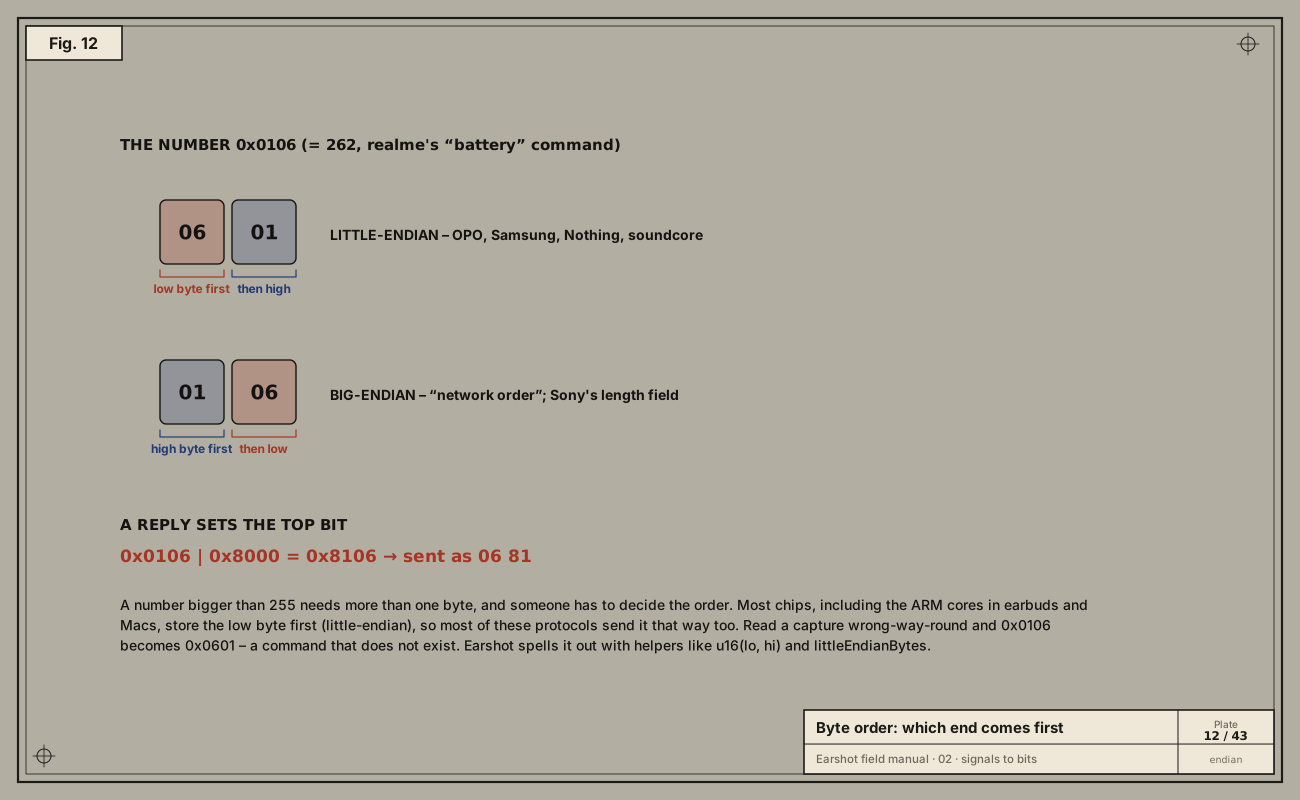
The realme “battery” command is the 16-bit number 0x0106. On the wire it must become two bytes, in some order:
- Little-endian: low byte first,
06 01. ARM and Intel processors work this way, and so do OPO, Samsung, Nothing and soundcore. - Big-endian: high byte first,
01 06. This is the classic “network order”, used by Sony’s 32-bit length field.
Read it the wrong way round and 0x0106 (battery) becomes 0x0601, a command that doesn’t exist. Earshot keeps the rule in two helpers (EarshotCore/Checksums.swift):
extension UInt16 {
    var littleEndianBytes: [UInt8] { [UInt8(self & 0xFF), UInt8(self >> 8)] }
}
func u16(_ lo: UInt8, _ hi: UInt8) -> UInt16 { UInt16(lo) | UInt16(hi) << 8 }
OPO marks a reply by setting the command’s top bit: 0x0106 | 0x8000 = 0x8106, sent as 06 81. A 81 in a frame’s sixth byte means “this is an answer”.
Many switches in one byte: bit masks
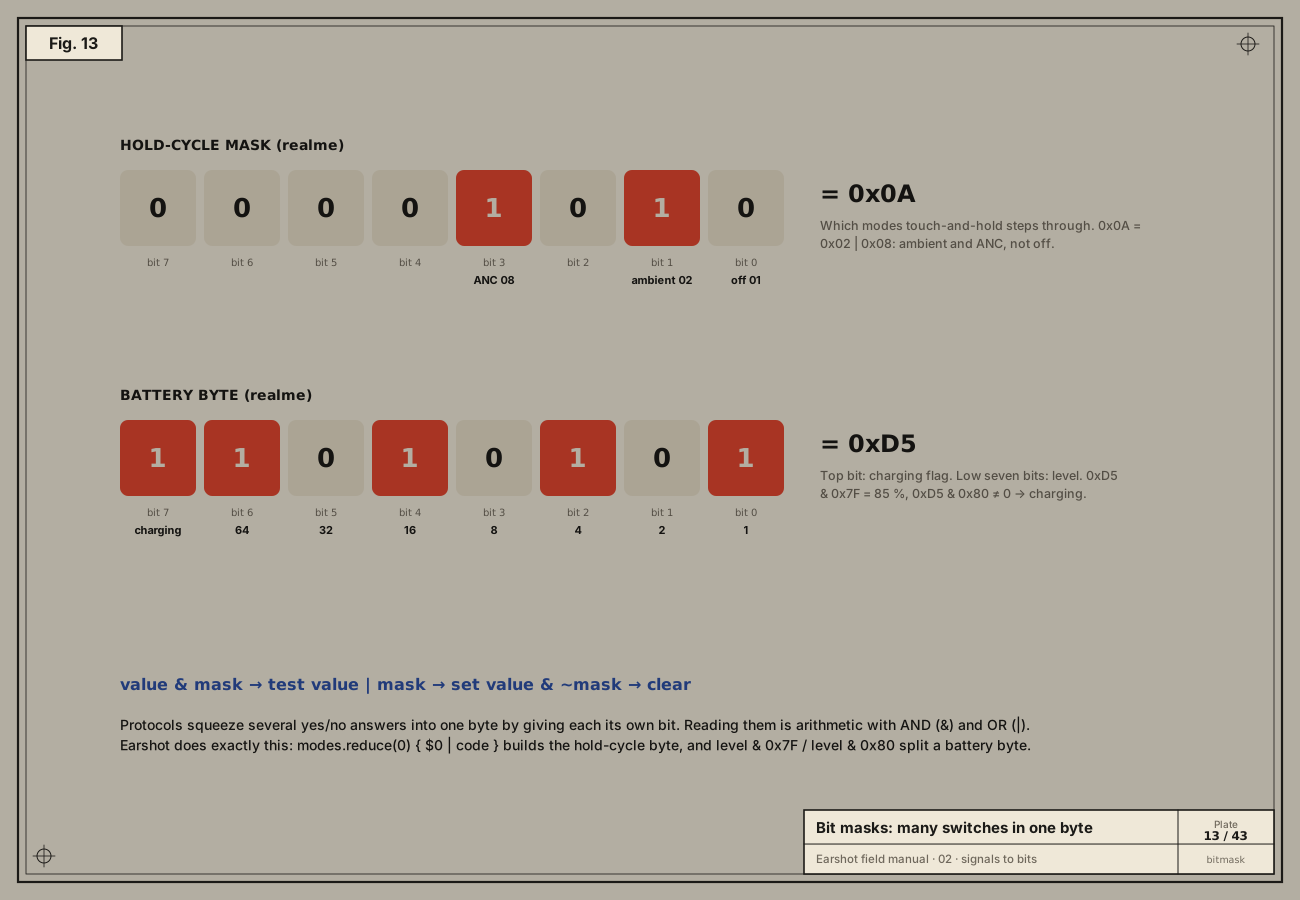
The hold-cycle mask. “Touch and hold” switches between noise modes, and you choose which. Each mode has its own bit: off 0x01, transparency 0x02, ANC 0x08. Combine with OR:
0x02 | 0x08 = 0x0A → hold cycles between transparency and ANCEarshot builds the byte in one line: modes.reduce(0) { $0 | OPOCode.mode($1) }.
The battery byte. The top bit means charging, and the low seven bits are the level:
0xD5 & 0x80 = 0x80  → charging
0xD5 & 0x7F = 0x55 → 85 %| Operation | Example | Effect |
|---|---|---|
value & mask | 0xD5 & 0x80 | test a bit |
value | mask | 0x02 | 0x08 | set a bit |
value & ~mask | 0x0A & ~0x02 | clear a bit (~ flips all bits) |
A length that grows: LEB128
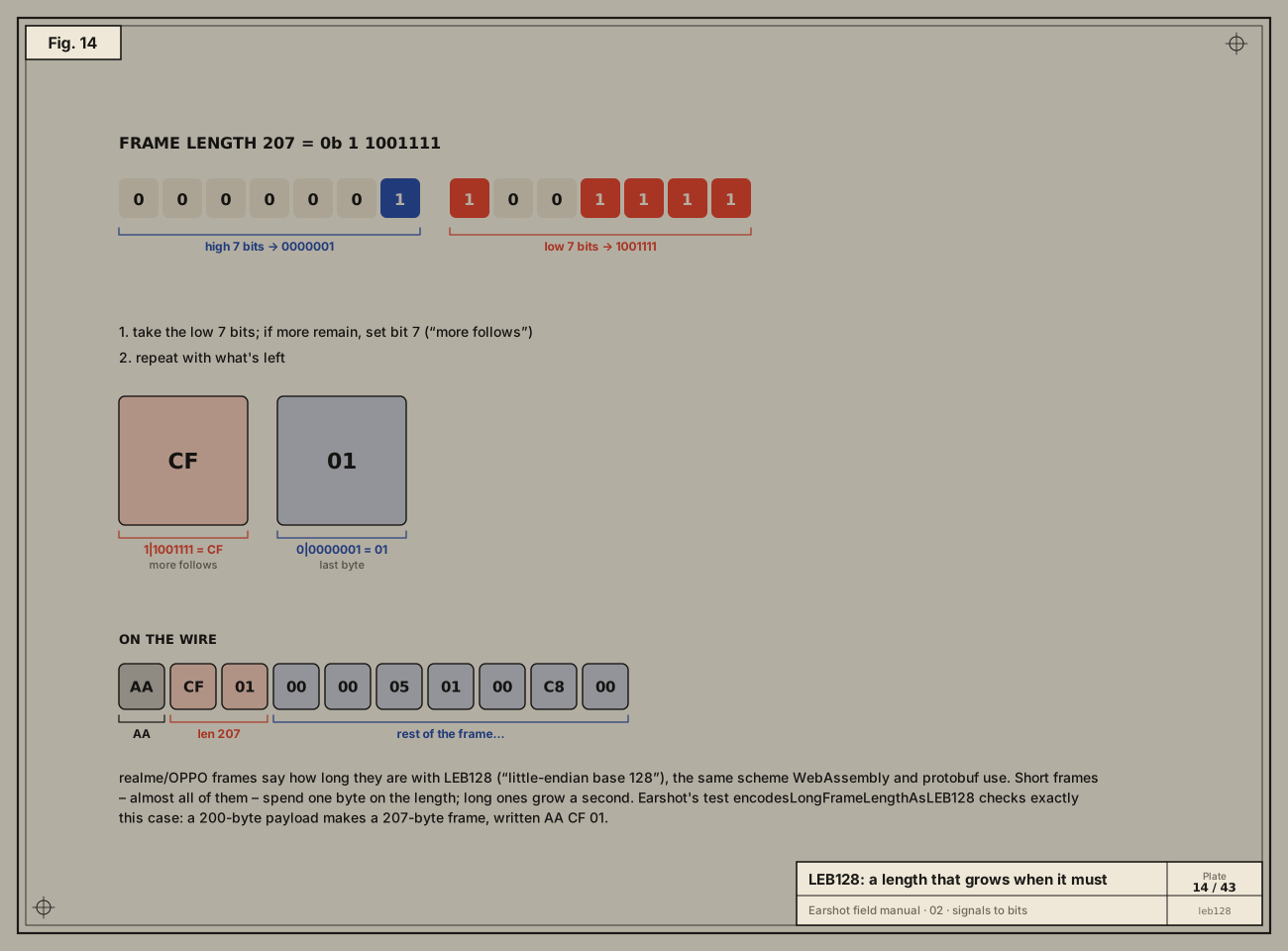
Every message must say how long it is (chapter 08). A one-byte length caps messages at 255 bytes; a four-byte length wastes three bytes on every small message. realme/OPPO frames use LEB128 (little-endian base 128), a variable-length scheme also used by WebAssembly and protocol buffers:
- Take the lowest 7 bits.
- If anything is left, set the top bit (“more follows”), write the byte, shift right by 7, and repeat.
- The last byte has its top bit clear.
So 13 is 0D, and 207 is CF 01. Earshot’s encoder:
static func encode(_ value: UInt) -> [UInt8] {
    var v = value
    var out: [UInt8] = []
    repeat {
        var byte = UInt8(v & 0x7F)
        v >>= 7
        if v != 0 { byte |= 0x80 }
        out.append(byte)
    } while v != 0
    return out
}
The test encodesLongFrameLengthAsLEB128 builds a frame with a 200-byte payload (frame length 207) and checks that it starts AA CF 01.
Take-aways
- Sound → voltage → samples → numbers, and back again.
- A bit is a voltage judged against a threshold. A byte is eight bits, and hex writes it as two digits.
- Multi-byte numbers have an order. Endianness mistakes are the most common protocol bug.
- Single bits can mean separate things (masks), and lengths can be encoded compactly (LEB128).
Next: 03 · Radio →