07 · OPO byte by byte
In the story: channel 15 is open and the buds answer. Now we have to speak their language fluently: every field, every command, every quirk. This is the protocol Earshot was born speaking.
realme, OPPO and OnePlus belong to the same group of companies, and their buds share one control protocol. We call it OPO after the three names. It runs over the RFCOMM service 0000079A-D102-11E1-9B23-00025B00A5A5 (channel 15 on the Buds Air 7). Command numbers match Gadgetbridge’s OPPO code, and everything below was verified against a realme Buds Air 7 on firmware 1.1.0.62.
The frame
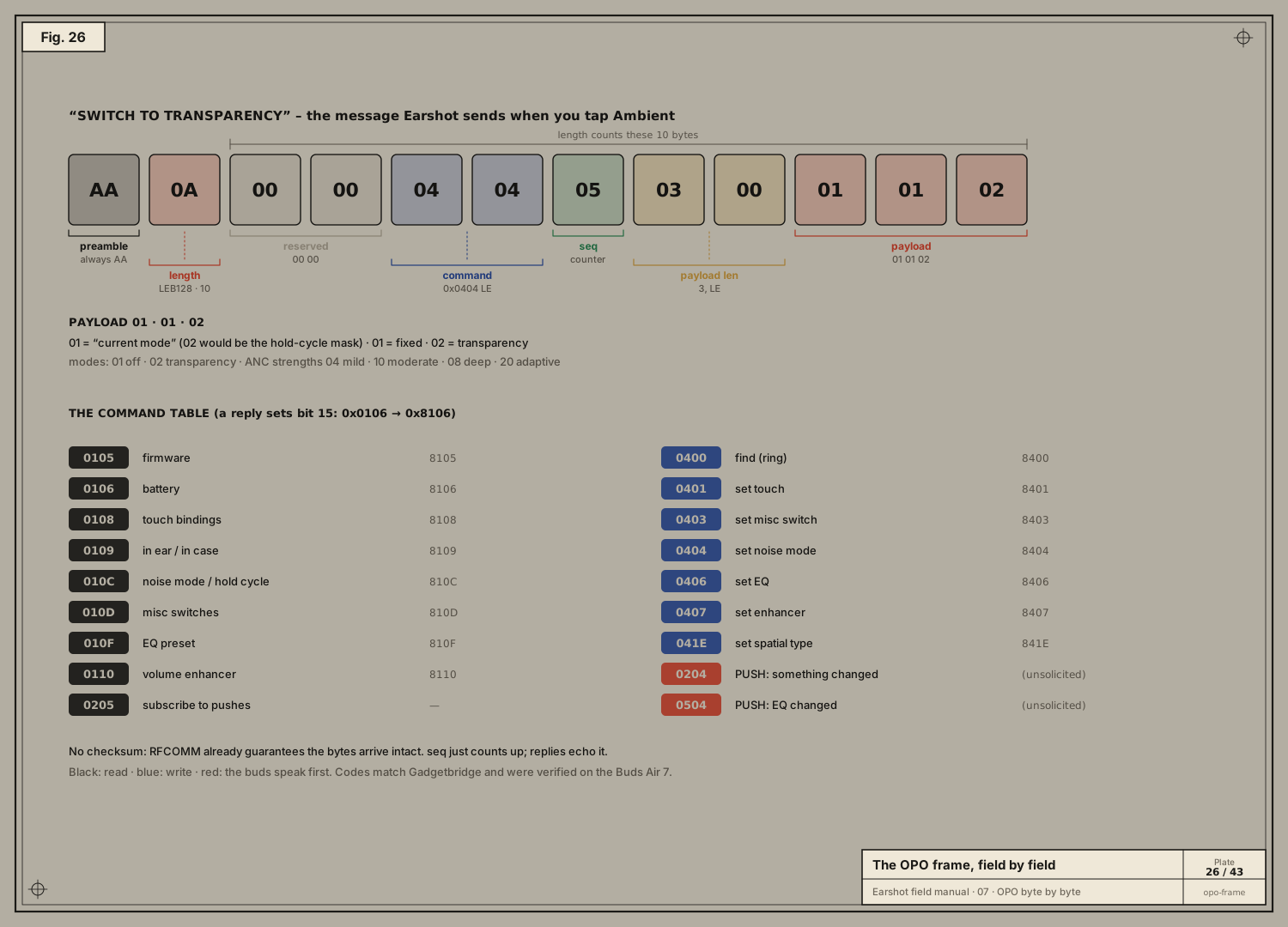
AA <len: LEB128> 00 00 <cmd: u16 LE> <seq: u8> <payloadLen: u16 LE> <payload…>| Field | Size | Meaning |
|---|---|---|
| preamble | 1 | always AA, the start marker the decoder hunts for |
| length | 1–2 | LEB128, counts everything after itself (7 header bytes + payload) |
| reserved | 2 | 00 00 |
| command | 2 | little-endian; replies set bit 15 (0x0106 → 0x8106) |
| seq | 1 | a counter Earshot increments per message; replies echo it |
| payload length | 2 | little-endian |
| payload | n | command-specific |
There is no checksum. RFCOMM already guarantees ordered, intact delivery (chapter 08). One quirk: some Buds Air 7 replies declare a payload length longer than they carry, so Earshot’s decoder trusts the outer frame length.
Earshot builds a frame like this:
public func encoded() -> [UInt8] {
    let body = 7 + payload.count
    var out: [UInt8] = [0xAA]
    out += LEB128.encode(UInt(body))
    out += [0x00, 0x00, UInt8(command & 0xFF), UInt8(command >> 8), seq]
    out += [UInt8(payload.count & 0xFF), UInt8((payload.count >> 8) & 0xFF)]
    out += payload
    return out
}
The commands
| Request | Meaning | Reply |
|---|---|---|
0105 | firmware versions | 8105 |
0106 | battery | 8106 |
0108 | touch bindings | 8108 |
0109 | wear status (in ear / out / case) | 8109 |
010C | noise mode, or hold-cycle mask | 810C |
010D | misc switches | 810D |
010F | EQ preset | 810F |
0110 | volume enhancer | 8110 |
0205 | subscribe to pushes | (none) |
0400 | find: ring / stop | 8400 |
0401 | set touch binding | 8401 |
0403 | set misc switch | 8403 |
0404 | set noise mode / hold cycle | 8404 |
0406 | set EQ | 8406 |
0407 | set volume enhancer | 8407 |
041E | set spatial type | 841E |
0204 | push: battery, wear, noise or game mode changed | — |
0504 | push: EQ changed | — |
Reads start 01, writes start 04, and pushes come from the buds on their own.
A question and its answer
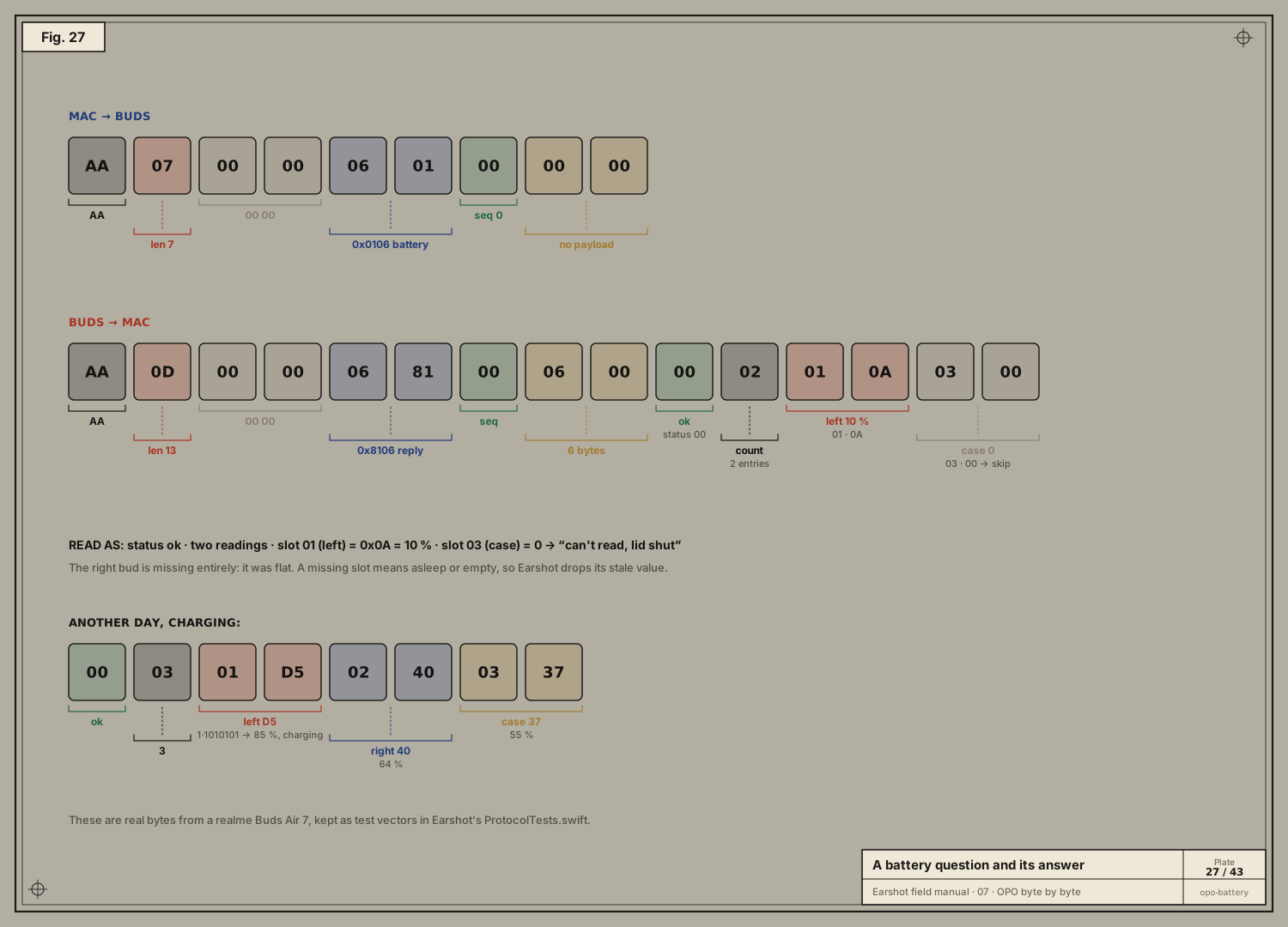
The request AA 07 00 00 06 01 00 00 00 is:
- the preamble, then length 7;
- reserved
00 00; - command
06 01=0x0106battery; - seq 0, payload length 0.
The reply AA 0D 00 00 06 81 00 06 00 00 02 01 0A 03 00 decodes as:
06 81=0x8106, the battery reply;- the payload
00 02 01 0A 03 00:- status
00(ok); 02readings;- slot
01(left) =0x0A= 10 %; - slot
03(case) =0, which Earshot skips because a zero with no charging flag means “can’t read”.
- status
Slot 02 (right) is missing entirely: that bud was flat.
Each level byte also carries the charging flag in its top bit. D5 = charging + 85 %.
A conversation
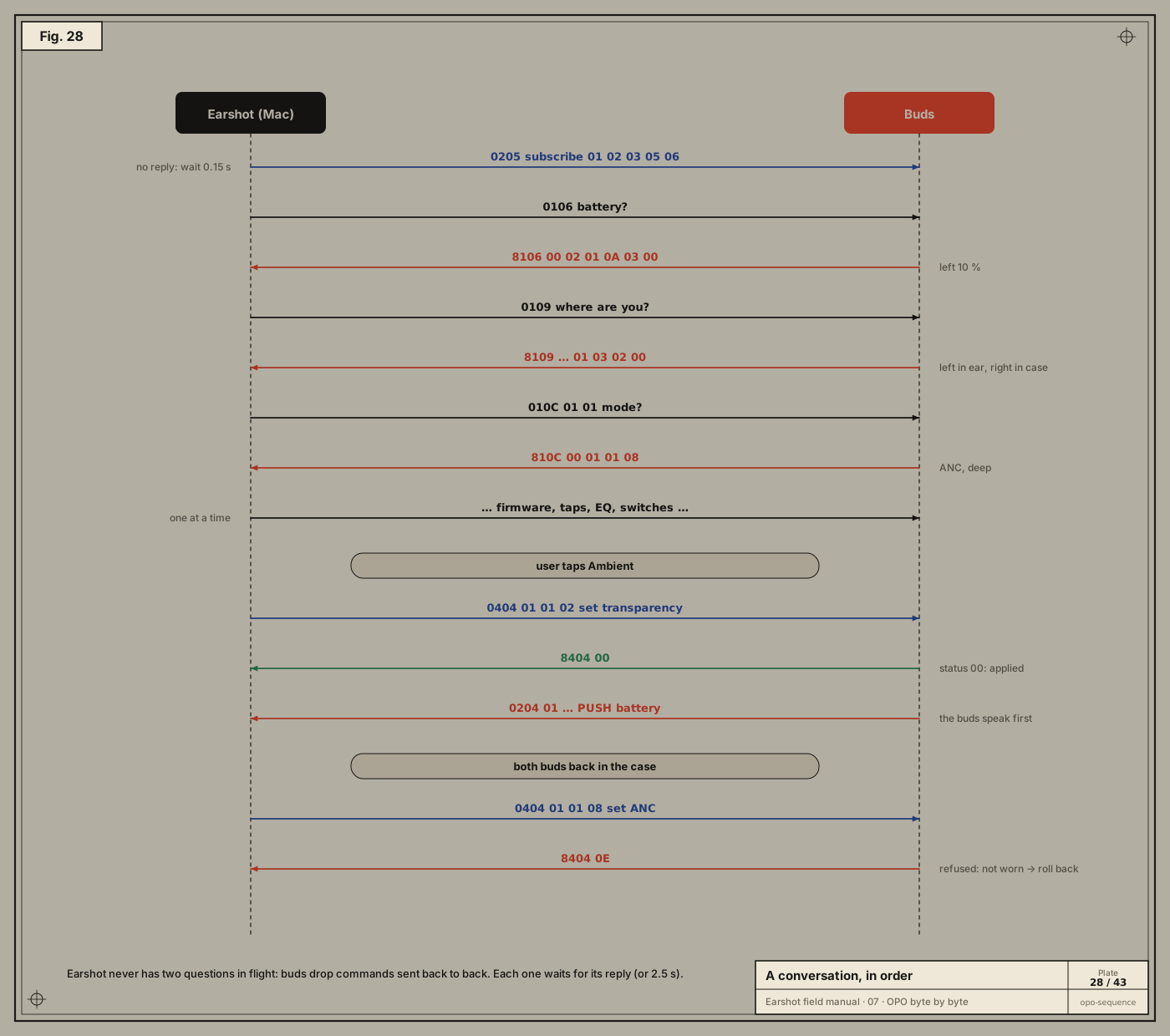
When the channel opens, OPODriver.start() queues:
0205subscribe with09 01 02 03 05 06: please push battery, wear, noise-mode and game-mode changes. It’s never acknowledged, so the link waits 0.15 s instead of for a reply.- Battery, wear status, noise mode, hold cycle, misc switches, firmware, touch bindings, EQ and volume enhancer, one at a time.
Then every 90 s it polls battery and wear status, and the buds push changes as they happen (0204).
Payload shapes
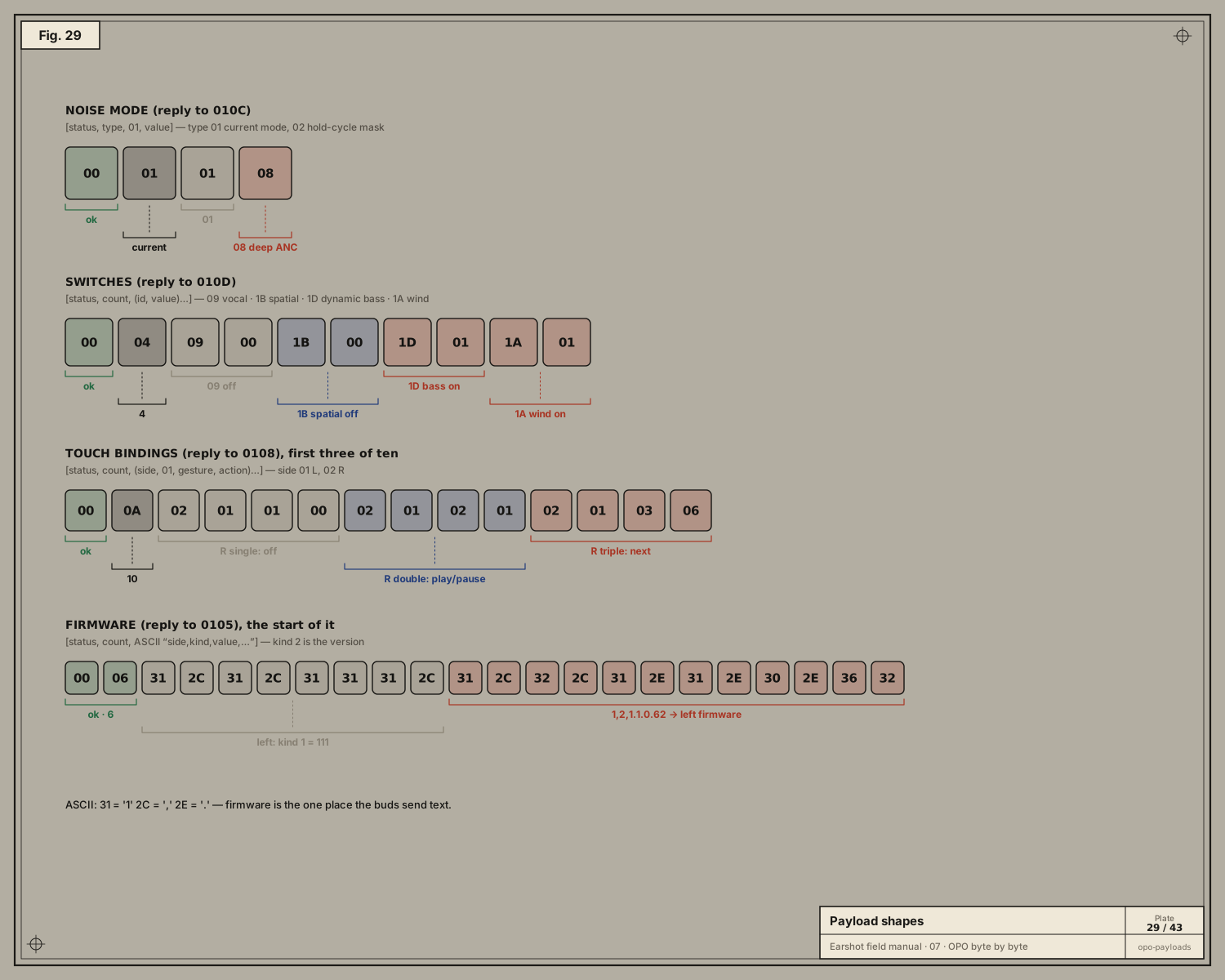
Noise mode (810C reply): [status, type, 01, value].
- Type
01is the current mode:01off,02transparency;- ANC strengths
04mild,10moderate,08deep,20adaptive.
- Type
02is the hold-cycle bitmask (chapter 02).
To set transparency, Earshot sends 0404 with 01 01 02. To set ANC, it sends the strength code: there is no separate “ANC on”. To change the hold cycle, it sends 0404 with 02 01 <mask>.
Misc switches (810D reply): [status, count, (id, value)…].
| id | Switch |
|---|---|
06 | game mode |
09 | vocal enhancement |
11 | dual-device |
18 | hi-res codec (LHDC) |
1A | wind-noise reduction |
1B | spatial audio |
1D | dynamic bass |
To change one, Earshot sends 0403 with [id, 00|01]. For spatial audio it also sends 041E [00|01], as realme Link does.
Touch bindings (8108 reply): [status, count, (side, 01, gesture, action)…].
- Sides:
01left,02right. - Gestures:
01single,02double,03triple,04hold. - Actions:
00none,01play/pause,04assistant,05previous,06next,08noise control,0Bvolume up,0Cvolume down,11game mode. - To set one:
0401 [01, side, 01, gesture, action].
Firmware (8105 reply): status, count, then ASCII text, "side,kind,value,…". Kind 2 is the version: 1,2,1.1.0.62 means left bud firmware 1.1.0.62. It’s the only text the buds ever send.
EQ: 810F [00, id] and pushes 0504 [00, id].
| id | Preset |
|---|---|
00 | Original |
01 | Deep bass |
02 | Serenade |
03 | Clear bass |
Acknowledgements and refusals
Every write is answered with the same command plus 0x8000, and a status byte:
| Status | Meaning |
|---|---|
00 | applied |
0E | refused: no bud in an ear (the Buds Air 7 refuse noise changes then) |
| other | refused, reason unknown, shown as its hex code |
A reply doesn’t say which setting it answers, only which command. Two different misc switches share 0403. So OPODriver.frame() records, per command, which setting was last written, and attributes the acknowledgement to it:
public func frame(_ message: Outgoing) -> [UInt8] {
    let command = u16(message.body[0], message.body[1])
    if let setting = message.setting { lastSetting[command] = setting }
    defer { seq &+= 1 }
    return OPOPacket(command: command, seq: seq, payload: Array(message.body[2...])).encoded()
}
After a refusal, or after any touch or enhancer change, the driver reads the setting back, so the UI shows the truth.
Next: 08 · Integrity →