09 · The other brands
In the story: after v1.0, the question was “Most earbuds that are not Apple, the ones sold in India and English-speaking countries. I don’t have them. Is that doable?” This chapter is the answer: five protocol families, learned from open work and captured messages, behind one interface.
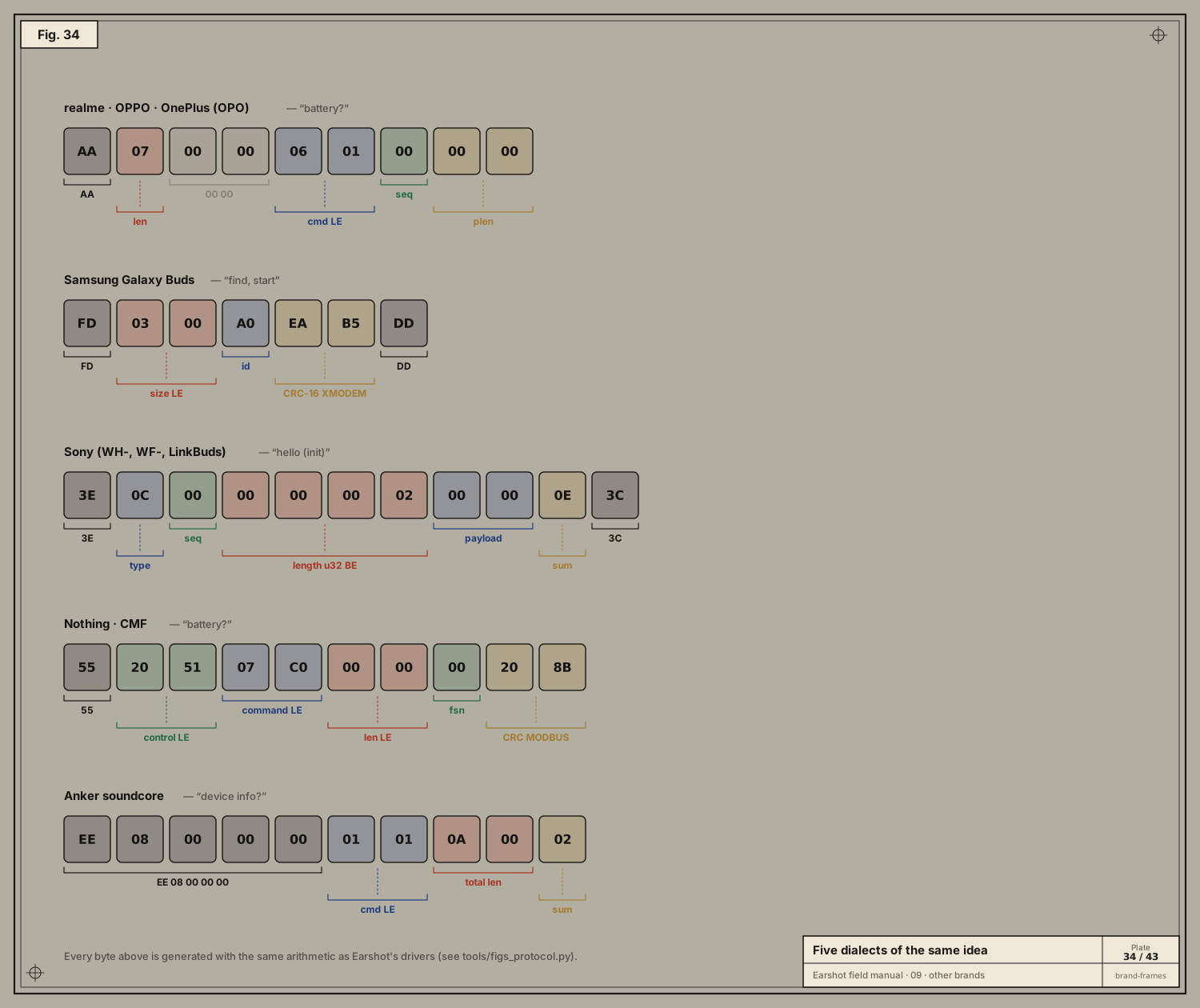
Every byte in this plate was computed with the same arithmetic as Earshot’s drivers. You can check them by running tools/figs_protocol.py.
realme · OPPO · OnePlus: OPO
Chapter 07. Tested on the realme Buds Air 7. Other realme, OPPO Enco and OnePlus Buds use the same driver and are marked beta. Their companion app is named in the UI (“realme Link” or “HeyMelody”).
Samsung Galaxy Buds
FD <header: u16 LE> <id> <payload…> <crc16: u16 LE> DD-
Service:
2E73A4AD-332D-41FC-90E2-16BEF06523F2on Buds2 and later, else plain SPP00001101-…. -
Header: the low 10 bits count id + payload + CRC.
-
Check: CRC-16/XMODEM over id and payload.
-
Status: the buds push it on their own.
0x61extended status arrives on connect. On Buds Live and later its layout is:[2]left %,[3]right %,[6]placement as two nibbles (left high, right low),[7]case %,[8]game mode,[9]EQ,[11]hold actions (nibbles),[12]noise mode. The Buds+ uses different offsets.0x60status update comes later.
-
Writes:
id Sets 0x78noise control: 0 off, 1 ANC, 2 ambient, 3 adaptive 0x80ambient, on the Buds+ 0x98ANC, on the Buds Live 0x86EQ preset, 0–5 0x85game mode 0x92touch-and-hold actions [left, right]: 1 assistant, 2 noise, 3 volume, 4 Spotify0xA0/0xA1find start / stop -
On connect Earshot sends a “manager info” message (
0x88 [01 01 22]) to introduce itself. -
Nothing is acknowledged, so changes count as applied when written, and the next status push shows the truth.
-
Model: detected from the name, e.g. “Galaxy Buds2 Pro (A1B2)”, even if renamed. The model decides which noise modes exist and whether hold actions are configurable.
Sony (WH-, WF-, LinkBuds, ULT Wear)
3E <type> <seq> <length: u32 BE> <payload…> <sum> 3C-
Service:
956C7B26-D49A-4BA8-B03F-B17D393CB6E2(newer) or96CC203E-5068-46AD-B32D-E316F5E069BA(older). -
Framing: delimited and escaped (chapter 08). The checksum is the byte sum of type through payload.
-
Types:
0x01ACK,0x0C/0x0Ecommands. Every command is ACKed withseq = 1 − theirs, and Earshot updates its own seq from their ACK. -
Hello: the init command is payload
00 00. A 4-byte reply means protocol v1; an 8-byte reply means v2. The version picks every later layout:Topic v1 v2 Battery [10 type]→0x11/0x13[22 type]→0x23/0x25Ambient / ANC get 0x66, set0x68, variant02same commands, variants 0x15,0x17,0x22EQ [56/58, 01, preset, 00][56/58, 00, preset, 00]- Battery types: single, dual, case.
- Ambient / ANC replies arrive as
0x67/0x69. - EQ presets: off, or
0x10–0x17.
-
Product: headphones (WH-, ULT Wear) show one battery and a headphones sprite.
Nothing · CMF
55 <control: u16 LE> <command: u16 LE> <length: u16 LE> <fsn> <payload…> <crc16: u16 LE>-
Service:
AEAC4A03-DFF5-498F-843A-34487CF133EB. -
Control word:
- bit
0x20means a CRC follows (CRC-16/MODBUS over everything before it); - the low 5 bits are a reply’s status;
- bit
0x40means frames are numbered (the Ear (a) needs it).
- bit
-
Commands:
Topic Read Push Write Battery C007(sent with control0x5120)E001— Audio mode C01EE003F00F [01, mode, 00]EQ C050— F01DUltra bass C04E— F051Spatial C04F— F052Low latency (1 on, 2 off) C041— F040Taps C018— F003Find — — F002- Audio modes:
05off,07transparency,01high,02mid,03light,04adaptive. - Tap gestures:
02double,03triple,07hold.
- Audio modes:
-
Product: capabilities depend on the name. “Ear (stick)” has no noise control, “Ear (1)” no adaptive ANC, and CMF models get EQ presets.
Anker soundcore
host:   EE 08 00 00 00 <command: u16 LE> <length: u16 LE> <payload…> <sum>
device: FF 09 00 00 01 <command: u16 LE> <length: u16 LE> <payload…> <sum>-
Service: a UUID starting
0CF12D31-FAC3-4553-BD80-D6832E7…that ends in the model number, which is why Earshot’sServiceMatchhas a.prefixcase. -
Framing:
lengthcounts the whole frame; the checksum is the byte sum before it. -
Commands:
Command Purpose 0101device info 0105extended info 8105session init 0301battery 0401charging 0106audio mode 8106set audio mode, with a model-specific trailer ( 01, or01 00on the Liberty 4 NC)8910find - Battery comes in fifths (raw × 20), or (raw + 1) × 10 on some newer models.
- Audio-mode payload:
[mode 0 ANC / 1 ambient / 2 off, strength 10/20/30, …].
-
Product: which noise modes exist is learned from the first audio-mode report.
At a glance
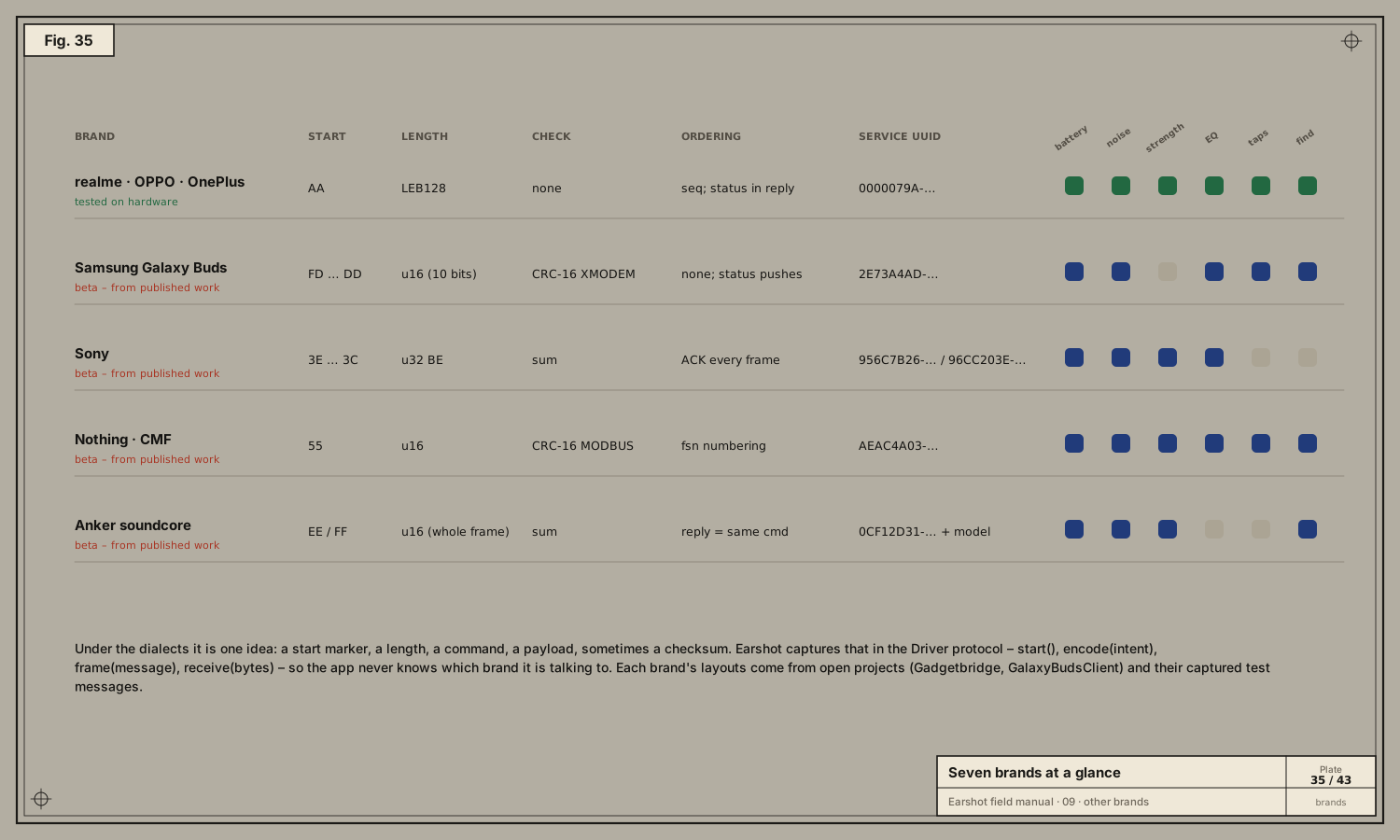
One interface for all of them
The app never knows which brand it’s talking to. Each brand implements the same small protocol (EarshotCore/Driver.swift):
public protocol Driver: AnyObject {
    var capabilities: Capabilities { get }            // which controls to show
    func start() -> [Outgoing]                       // sent once the channel opens
    func poll() -> [Outgoing]                        // every 90 s
    func encode(_ intent: Intent) -> [Outgoing]      // "set ANC deep" → messages
    func frame(_ message: Outgoing) -> [UInt8]       // final bytes at send time (seq numbers)
    func receive(_ bytes: [UInt8]) -> Inbound        // bytes → events, replies, ACKs
}- Capabilities list what a model can do, so the UI shows only controls that work.
- Intents are brand-neutral requests:
setNoise(.cancel, level: .deep),setEq(2),setTouch(…),find(true). - Events are brand-neutral facts:
.battery([…]),.placement([…]),.noiseMode(…),.applied(.noise),.refused(.noise, code: 0x0E).
Adding a brand means writing one driver and one profile. The UI, the link and the store don’t change.
Honesty about “beta”
Only the Buds Air 7 has been tried on real hardware. Every other family is built from published protocol work and other people’s captured messages. The parsers are tested against those captures, but behaviour such as timing, refusals and model quirks can only be confirmed by an owner. The app shows beta in the header for those models, and asks for a report.
Next: 10 · The app →