08 · Integrity: where messages begin, end, and stay correct
In the story: the first replies sometimes arrived glued together, or split across two callbacks. The decoder had to learn to find the edges of messages in a stream of bytes, and the other brands each protect their messages differently. This chapter is the theory behind all of that.
A stream has no edges
An RFCOMM channel is like a pipe of water: bytes come out in the order they went in, but there are no gaps between “messages”. Two writes can arrive as one chunk; one write can arrive in two. Every protocol needs a framing rule.
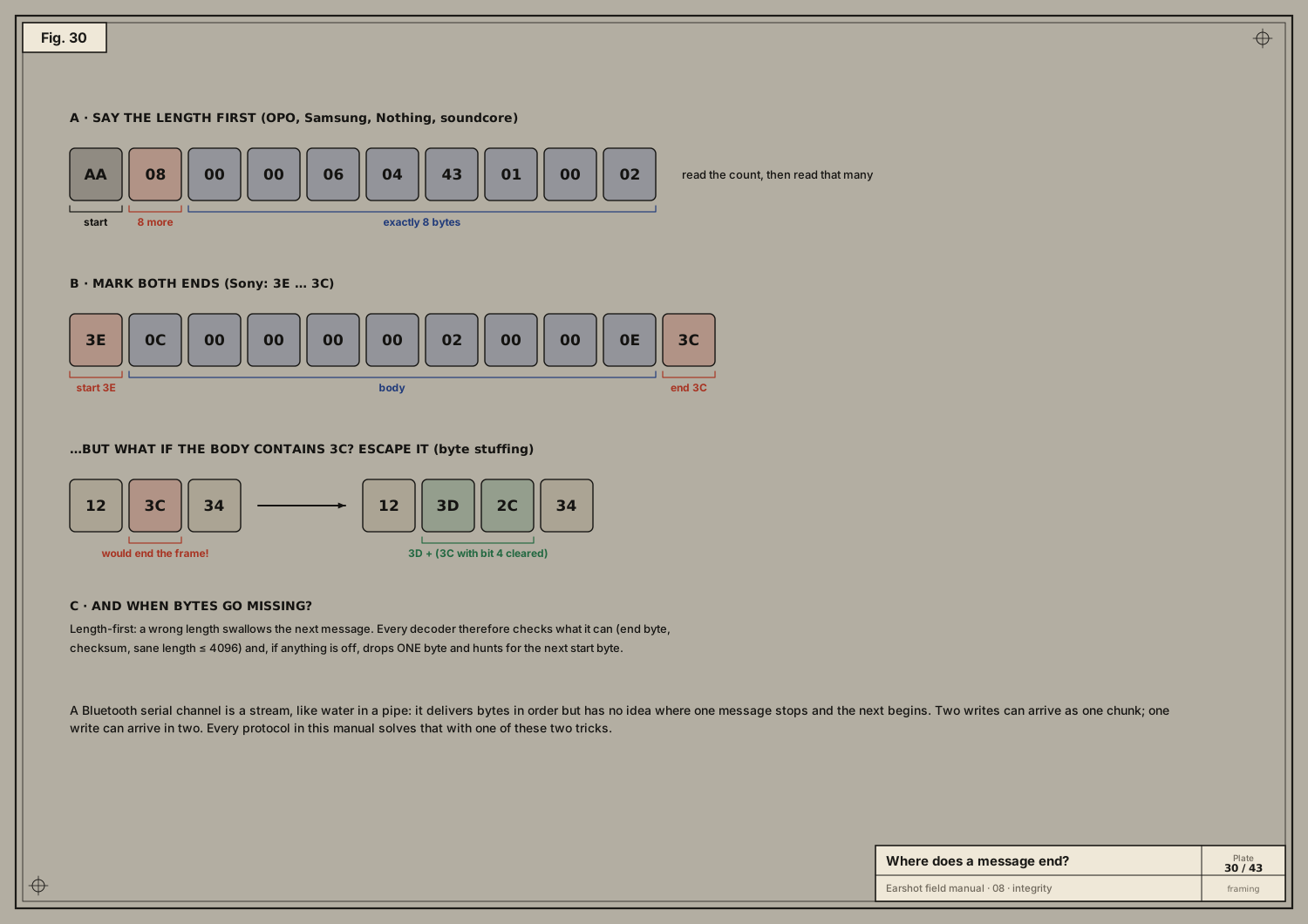
A · Length first. Start with a recognisable byte, then say how many bytes follow. The reader takes the count and reads exactly that many.
| Protocol | Start | Length field |
|---|---|---|
| OPO | AA | LEB128 |
| Samsung | FD | 10-bit size, ending DD |
| Nothing | 55 | a 16-bit length |
| soundcore | EE/FF | a 16-bit total |
The risk: if the length is corrupted, you swallow part of the next message.
B · Mark both ends. Sony starts every frame with 3E and ends it with 3C. Simple, but what if a 3C appears inside the message? It must be escaped (byte stuffing):
- Sony replaces any
3C,3Dor3Ein the body with3Dfollowed by the byte with bit 4 cleared, so3Cbecomes3D 2C. - The reader reverses it: after a
3D, OR the next byte with0x10.
static func escape(_ bytes: [UInt8]) -> [UInt8] {
    bytes.flatMap { [0x3C, 0x3D, 0x3E].contains($0) ? [0x3D, $0 & 0xEF] : [$0] }
}
C · Recovering. Any decoder will eventually see garbage: a byte lost, a frame cut by a disconnect. Earshot’s decoders check everything they can: start byte, end byte, checksum, and a sane length of at most 4096. If anything is off they drop one byte and hunt for the next start byte. This resync means one bad byte costs at most one message, never the connection.
Rebuilding messages from chunks
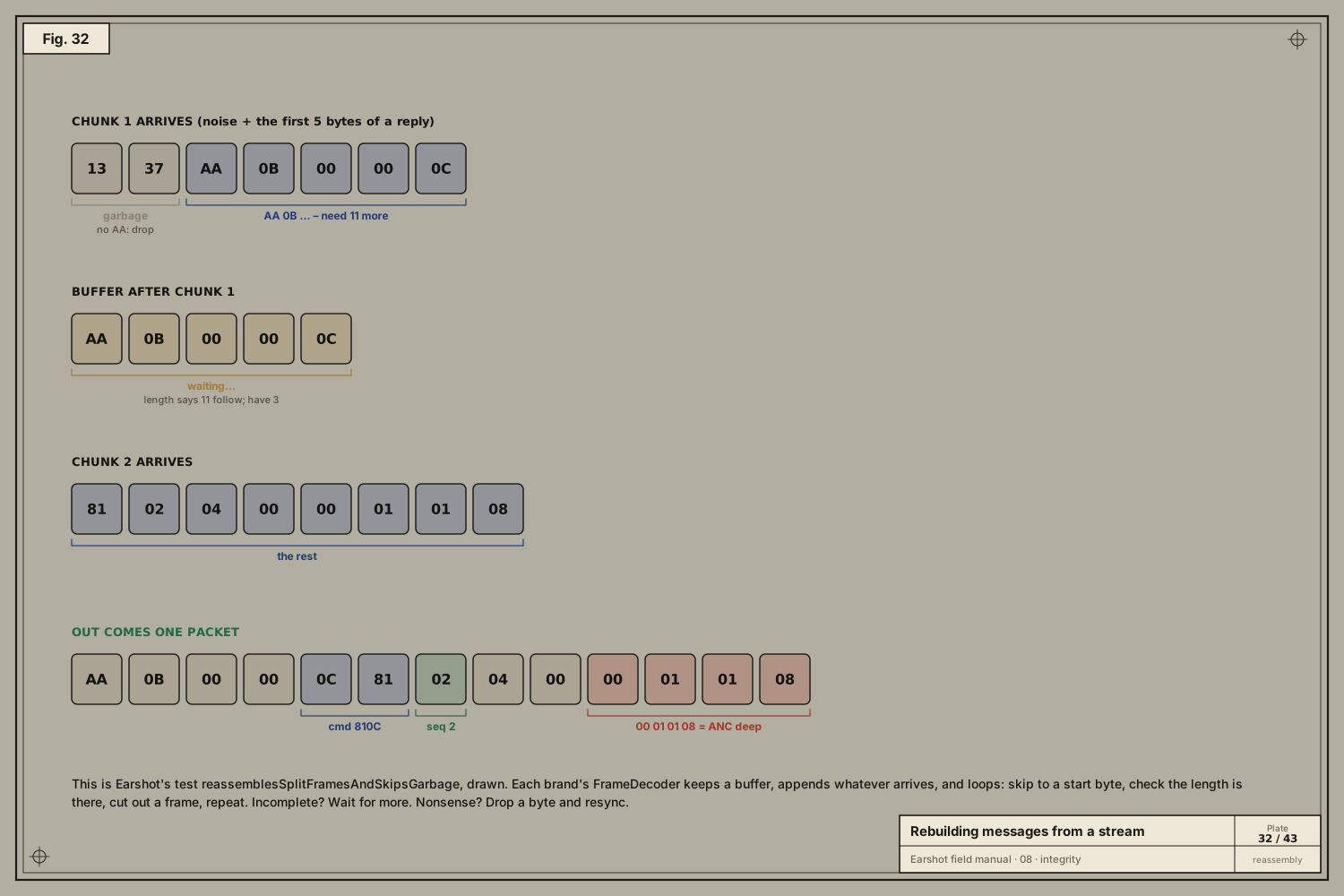
Every brand’s FrameDecoder has the same loop:
public mutating func feed(_ bytes: [UInt8]) -> [OPOPacket] {
    buffer += bytes
    var packets: [OPOPacket] = []
    while !buffer.isEmpty {
        guard buffer[0] == 0xAA else {                     // resync on the next preamble
            buffer.removeFirst(buffer.firstIndex(of: 0xAA) ?? buffer.count)
            continue
        }
        guard let (length, lenSize) = LEB128.decode(buffer[1...]) else { break }    // need more bytes
        guard length >= 7, length <= 4096 else { buffer.removeFirst(); continue }   // nonsense: skip
        let start = 1 + lenSize
        guard buffer.count >= start + length else { break }                       // incomplete: wait
        let body = Array(buffer[start..<(start + length)])
        buffer.removeFirst(start + length)
        packets.append(OPOPacket(command: UInt16(body[2]) | UInt16(body[3]) << 8, seq: body[4], payload: Array(body[7...])))
    }
    return packets
}
The test reassemblesSplitFramesAndSkipsGarbage feeds 13 37 plus the first five bytes of a reply, gets nothing, then feeds the rest and gets exactly one packet: ANC, deep.
Seeing it on a raw capture
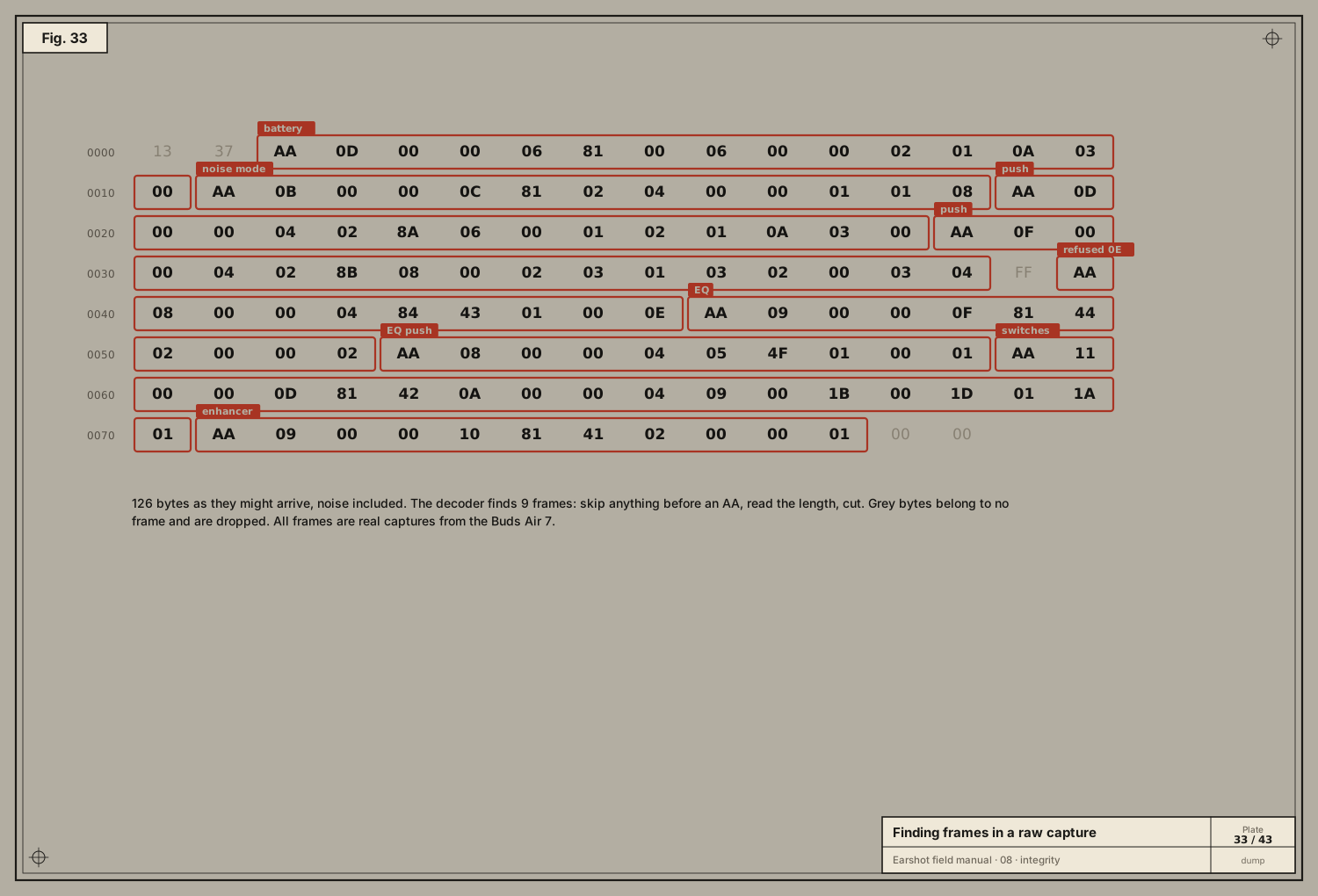
Here are 126 bytes as they might arrive, with stray bytes mixed in. Walking them the way the decoder does finds nine frames: battery, noise mode, two pushes, a refusal, EQ, an EQ push, switches and the enhancer. The grey bytes belong to nothing and are dropped.
Checksums: did the bytes change?
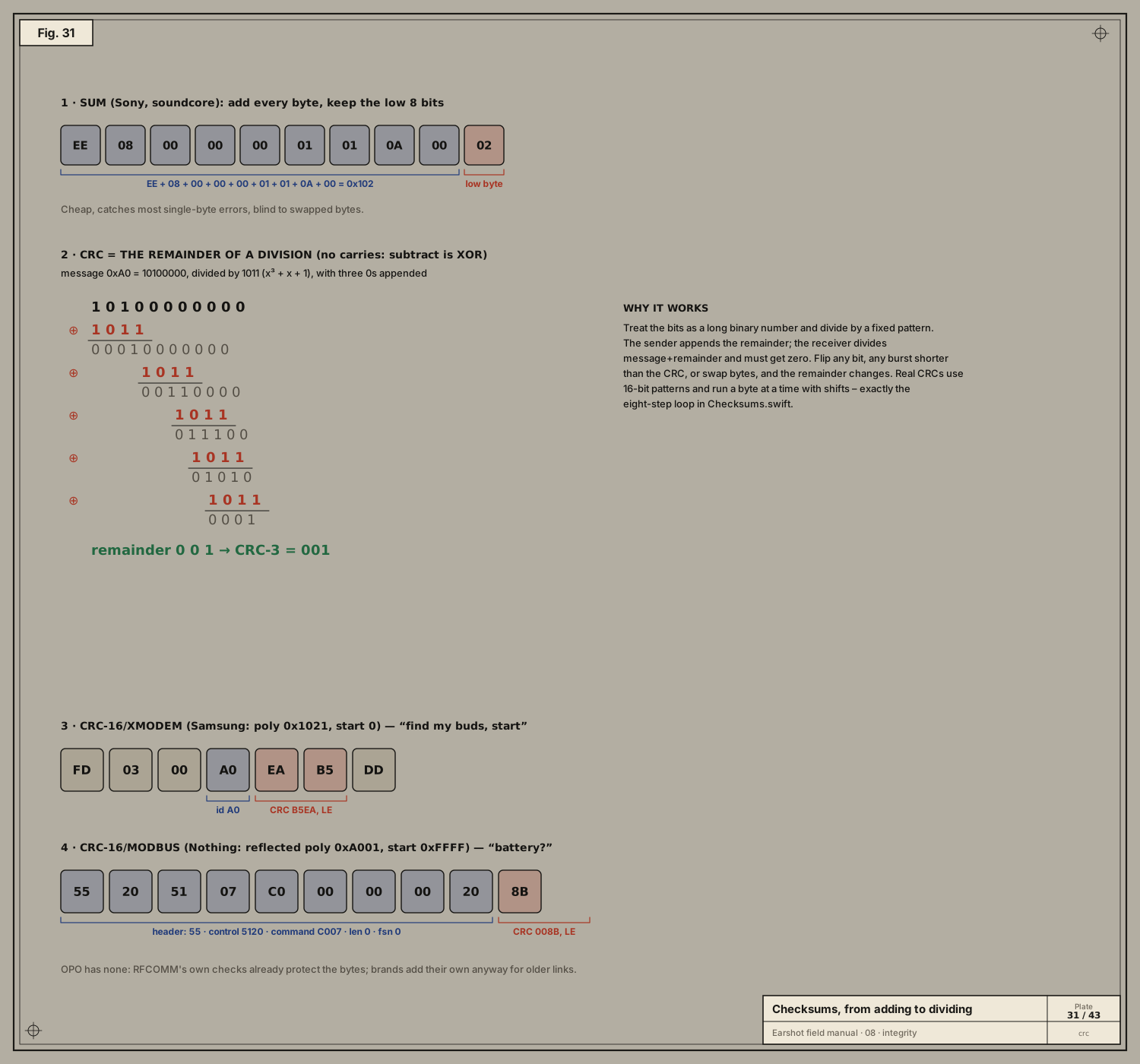
Radio links have their own error checks (chapter 04), but many brands add one inside their messages too. Their protocols were designed for older or rougher links, and it costs little.
Sum. Add every byte and keep the low 8 bits. Sony and soundcore use it. It’s cheap and catches most single-byte errors, but it’s blind to swapped bytes, since addition doesn’t care about order.
CRC (cyclic redundancy check). Treat the whole message as one long binary number and divide it by a fixed binary pattern, the generator polynomial. The arithmetic has no carries: subtraction is XOR. The remainder is the CRC.
- The sender appends it.
- The receiver divides message + CRC and must get zero.
The plate works a tiny 3-bit example by hand. Real CRCs use 16-bit generators and process a byte at a time with shifts. They detect every single-bit error, every two-bit error, any odd number of flipped bits, and any burst shorter than the CRC.
Two CRC-16 variants appear in Earshot:
/// CRC-16/XMODEM (poly 0x1021, init 0), used by Samsung.
static func crc16Xmodem(_ bytes: [UInt8]) -> UInt16 {
    var crc: UInt16 = 0
    for byte in bytes {
        crc ^= UInt16(byte) << 8
        for _ in 0..<8 { crc = crc & 0x8000 != 0 ? (crc << 1) ^ 0x1021 : crc << 1 }
    }
    return crc
}

/// CRC-16/MODBUS (reflected poly 0xA001, init 0xFFFF), used by Nothing.
static func crc16Modbus(_ bytes: [UInt8]) -> UInt16 {
    var crc: UInt16 = 0xFFFF
    for byte in bytes {
        crc ^= UInt16(byte)
        for _ in 0..<8 { crc = crc & 1 != 0 ? (crc >> 1) ^ 0xA001 : crc >> 1 }
    }
    return crc
}
They differ in three ways:
- Bit direction: XMODEM processes the high bit first; MODBUS is “reflected” and processes the low bit first, so its polynomial 0x8005 appears reversed as 0xA001.
- Starting value: 0 versus 0xFFFF.
- Byte order of the result: both are sent little-endian here.
One real-world wrinkle: Nothing’s incoming CRCs in published captures don’t match CRC-16/MODBUS, so, like Gadgetbridge, Earshot computes the CRC on what it sends but doesn’t reject replies over it. Trust the device.
Sequence numbers and acknowledgements
Framing finds messages; numbering keeps them in order and pairs answers with questions:
- OPO: a
seqbyte that the reply echoes, plus a status byte. - Sony: every frame must be ACKed with a tiny frame carrying the other side’s sequence number flipped (
1 − seq). Miss an ACK and the headphones resend. Earshot’s Sony driver writes these ACKs immediately, ahead of its queue (Inbound.immediate). - Nothing: a frame sequence number (
fsn), with a control bit saying it is in use. - Samsung: no acknowledgement at all. The buds simply push their new status; Earshot marks a change as applied as soon as it’s written (
appliedOnWrite).
Take-aways
- Streams need framing: length-prefixed or delimited, with escaping.
- Decoders must buffer, wait and resync.
- Checksums range from a simple sum to CRCs, which are polynomial division without carries.
- Sequence numbers and ACKs pair answers with questions, and every brand does it differently.
Next: 09 · The other brands →